
Digital Media Platform & Talk Show
1804 Renaissance
High-impact conversations redefining Haiti’s global narrative while connecting the Haitian diaspora with the homeland through history, cultural pride, and future innovation.

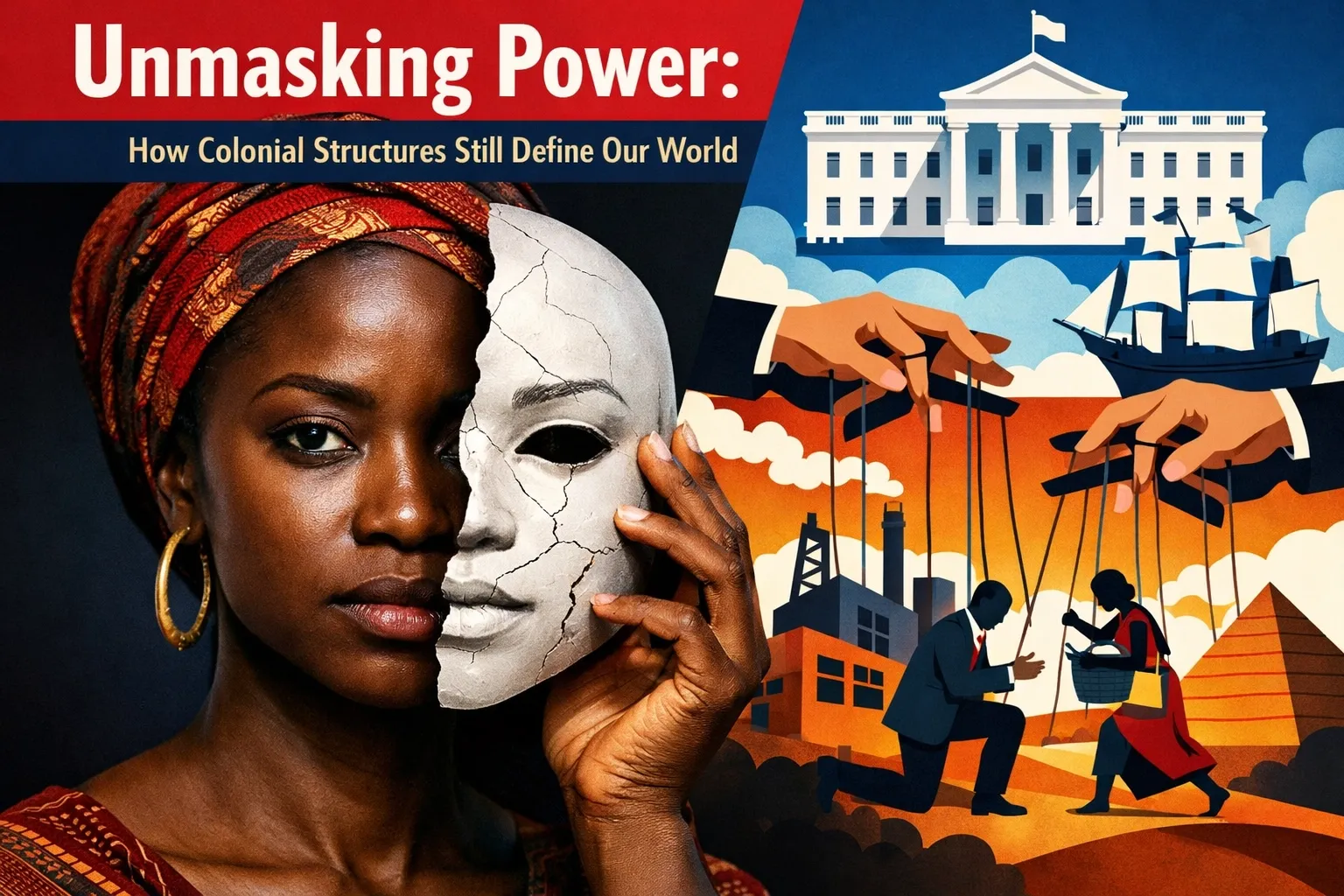
Do you ever feel like you are walking through a house where the hallways were built for someone else’s height?
We live in a world that feels natural, yet every corner of it is a design.
A design intended to facilitate extraction.
A design intended to prioritize the center while starving the periphery.
We call this history.
But history is not a static museum of the past; it is the invisible architecture of our present.
The structures of power that were erected five centuries ago did not vanish with the lowering of a colonial flag.
They simply became more efficient.
The colonial project was never just about land.
It was about the systemic engineering of human value.
It was about deciding whose resources were "natural" and whose industries were "civilized."
When we look at the global economic landscape today, we see the echoes of extractive institutions.
These are systems designed not to create wealth within a community, but to funnel it outward.
Think about the railways.
Think about the ports.
In many post-colonial nations, the infrastructure does not connect cities to each other; it connects the interior to the coast.
It was built to export.
It was built to drain.
We see this same pattern in modern neoliberal policies that demand austerity from the poor to guarantee security for the global creditor.
The names of the players have changed, but the script remains the same.

The most dangerous border is the one drawn inside the skull.
We talk about the colonial mentality as if it is a relic of a bygone era.
It is not.
It is a living, breathing software that runs in the background of our consciousness.
It is the voice that tells us that imported goods are superior to local ones.
It is the impulse that makes us prioritize European languages over our mother tongues.
It is the fractured sense of self that seeks validation from the very systems that once shackled our ancestors.
The Haitian Revolution of 1804 remains the ultimate blueprint for breaking this cycle.
It was not merely a military victory.
It was a refusal to be defined by the master's logic.
It was a declaration that the mind could be liberated before the body was even free.
This theme of reclaiming our internal landscape is the core of my upcoming intellectual work, Decolonization of the Mind.
It is the necessary next step in our evolution.
Not just to change our rulers, but to change our rules.
Language is not just a tool for communication; it is a vessel for a worldview.
When a colonial power imposes its language, it imposes its history, its metaphors, and its hierarchy.
To speak a language is to inhabit a world.
If your language has no word for "ownership" but ten words for "stewardship," your relationship with the earth is fundamentally different.
When we are forced to process our pain through a vocabulary that was designed to silence us, we remain trapped.
We find ourselves unable to articulate our own liberation.
We use their definitions of "success."
We use their definitions of "progress."
We use their definitions of "sanity."
The courage to speak our own truth requires the courage to unlearn the words we were given.

Consider the environmental legacy of colonial structures.
The destruction of indigenous ecosystems was not an accident; it was a requirement for industrial expansion.
Forests were cleared for monoculture.
Rivers were diverted for mines.
Today, we face a climate crisis that is the direct result of this centuries-old logic of infinite growth on a finite planet.
The global south continues to pay the highest price for a fire they did not start.
This is the manifestation of the "extractive institution" on a planetary scale.
We see the same mechanism in our education systems.
We are taught to memorize facts, not to question the frameworks that make those facts significant.
We are trained to be cogs in a machine that we did not build.
Not to process life, but to endure it.
Not to create value, but to be a value.
How do we begin the process of dismantling these structures?
It starts with the recognition that the world we see is not the only world possible.
It requires an intellectual bravery to look at our traditions and ask: "Is this mine, or was it planted here?"
This is the journey I explore in my book, Alike Regardless: This Is Where It Began.
In it, I examine the roots of our shared human condition and the artificial divisions that keep us apart.
We must understand where it began if we are ever to decide where it ends.
Unity is not the erasure of our differences; it is the dismantling of the hierarchies that make those differences a weapon.

Decolonization is not a metaphor.
It is not a trend for academic journals or social media hashtags.
It is the visceral, daily work of reclaiming your own psyche.
It is the refusal to sanctify systems that do not see your humanity.
The power of the colonial structure lies in its ability to make itself feel inevitable.
It wants you to believe that there is no other way.
But 1804 proved that the inevitable is often just a lack of imagination.
The chains are heavy, but they are made of metal, not of spirit.
The mind is the final frontier.
The mind is the site of the ultimate revolution.
We must find the courage to see the cage.
Only then can we walk through the door.
Power is never given; it is unmasked.
And once you see how the world was built, you realize that you have the power to rebuild it.

The structures are old, but the spirit is ancient.
The blueprint can be redrawn.
The mind can be liberated.
This is where it begins.

Listen, reflect, and join the conversation
Explore Haitian history, cultural pride, identity, mental liberation, and the beliefs that shape how we understand ourselves and the world.
Digital Media Platform & Talk Show
High-impact conversations redefining Haiti’s global narrative while connecting the Haitian diaspora with the homeland through history, cultural pride, and future innovation.

Podcast
Thought-provoking conversations examining inherited beliefs about faith, language, history, culture, education, identity, and human worth.

