
Digital Media Platform & Talk Show
1804 Renaissance
High-impact conversations redefining Haiti’s global narrative while connecting the Haitian diaspora with the homeland through history, cultural pride, and future innovation.

What does it cost to be the first to say "no" to a world that has already decided your worth is zero?
What does it mean to dismantle a system that the rest of the world considers divine law?
In 1804, a small Caribbean island didn’t just win a war.
It shattered a global reality.
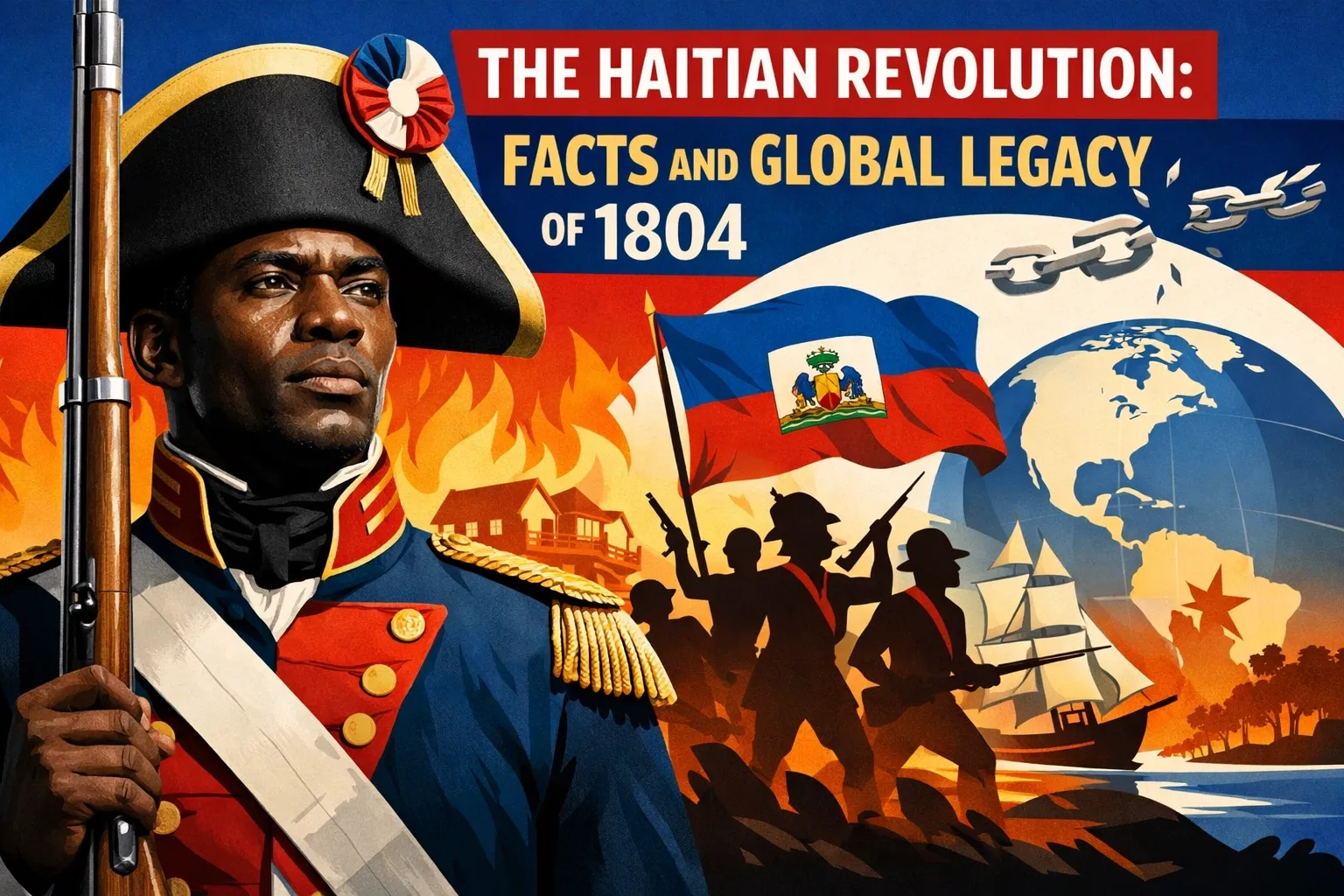
The Haitian Revolution remains the only successful insurrection of enslaved people in human history that resulted in the creation of an independent state.
It was not merely a rebellion.
It was a psychological earthquake.
To understand haitian revolution facts, one must first understand the climate of Saint-Domingue in the late 18th century.
It was the "Pearl of the Antilles," the wealthiest colony in the world, built entirely on the systematic extraction of human life.
The logic of the time suggested that the enslaved were incapable of governance, strategy, or unity.
The world was wrong.
In August 1791, the signal was given at Bois Caïman.
The revolt was not a frantic outburst of rage.
It was a calculated, synchronized strike against the machinery of empire.

The courage to dream beyond the plantation.
The courage to organize in the shadows of the night.
The courage to face the most powerful militaries on the planet with nothing but the conviction of their own humanity.
Toussaint Louverture, a former slave, emerged as the revolution’s primary architect.
He was a strategist who outmaneuvered the French, the Spanish, and the British.
He turned a fractured population into a disciplined army.
He saw a future that even the Enlightenment thinkers in Europe were too blind to imagine.
By 1801, Louverture had conquered the entire island of Hispaniola.
He abolished slavery and declared himself Governor-General for life.
But Napoleon Bonaparte could not allow a Black republic to exist in a world fueled by the slave trade.
Napoleon sent 43,000 troops to restore the "order" of the whip.
Louverture was captured and died in a cold French prison in 1803.
He died in a cage, but the fire he started was uncontainable.
Jean-Jacques Dessalines took the mantle.
On November 18, 1803, at the Battle of Vertières, the French army: the same army that had conquered much of Europe: was decisively defeated by former slaves.
On January 1, 1804, Haiti was born.
It was the first Black republic.
It was the second independent nation in the Western Hemisphere.
It was a beacon that the rest of the world tried desperately to extinguish.
We often speak of the external battles, but we rarely discuss the internal ones.
The global powers of the 19th century did not just respond with military threats; they responded with isolation.
They built a wall of silence around Haiti.
They forced the new nation to pay a "double debt" to France for the loss of "property": the property being the bodies of the Haitian people themselves.
This is where the concept of the Decolonization of the Mind becomes vital.
The physical chains were broken in 1804, but the psychological scaffolding of colonialism was left standing.
We see it in the way history is taught.
We see it in the way we view our own potential.
We see it in the "internalized colonialism" that suggests we still need validation from the systems that once enslaved us.

The revolution was won on the battlefield, but the war for the mind is ongoing.
My upcoming work, Decolonization of the Mind, explores this very frontier.
It asks how we sanctify our own narratives after centuries of being told our stories are secondary.
It examines how we move from surviving a system to thriving outside of it.
When we look at the haitian revolution facts, we see a legacy of global influence that is often erased.
Haiti provided sanctuary and resources to Simón Bolívar, the "Liberator" of South America, on the condition that he abolish slavery in the lands he freed.
Haiti was the heartbeat of human rights before the world even knew how to define them.
Yet, we are conditioned to view Haiti through the lens of poverty rather than the lens of power.
We are taught to see the struggle, but not the strength that necessitated the struggle.
Not to process the pain, but to endure it.
Not to remember the victory, but to dwell on the penalty.
This displacement of memory is a colonial tool.
It is designed to make the descendant of the revolutionary feel like a victim of history rather than an heir to a legacy.
To reclaim the legacy of 1804, we must look beyond the dates and the battles.
We must look at the fundamental truth the Haitian Revolution asserted: that human liberty is universal and non-negotiable.
In my book, Alike Regardless: This Is Where It Began, I explore the intersections of our shared humanity.
I delve into how we navigate a world that seeks to categorize us into silos of "us" and "them."
The Haitian Revolution was the ultimate rejection of those silos.
It was a visceral declaration of human unity.
It proved that the spirit cannot be colonized forever.

The work of 1804 is not finished.
It continues every time a person chooses to unlearn a lie they were told about their ancestors.
It continues every time we choose to decolonize our perception of what is possible.
It continues when we realize that the mind is the final territory to be liberated.
History is not a collection of dead facts.
It is a living, breathing influence on the choices we make today.
The Haitian Revolution was a masterclass in the power of the human will.
It was the moment the world realized that "normalized" oppression is never permanent.
We are the descendants of that realization.
The chains are gone.
The mind is next.
1804 was not just the end of a war; it was the beginning of a global awakening.
And that awakening is still happening.
If you are looking to explore the roots of human connection and the narratives that shape our world, I invite you to read my book, Alike Regardless: This Is Where It Began. Let us continue the conversation on what it means to be truly free.

Listen, reflect, and join the conversation
Explore Haitian history, cultural pride, identity, mental liberation, and the beliefs that shape how we understand ourselves and the world.
Digital Media Platform & Talk Show
High-impact conversations redefining Haiti’s global narrative while connecting the Haitian diaspora with the homeland through history, cultural pride, and future innovation.

Podcast
Thought-provoking conversations examining inherited beliefs about faith, language, history, culture, education, identity, and human worth.

