
Digital Media Platform & Talk Show
1804 Renaissance
High-impact conversations redefining Haiti’s global narrative while connecting the Haitian diaspora with the homeland through history, cultural pride, and future innovation.

Category: Power, Systems & Colonial Structures
History is rarely a straight line.
It is a series of ruptures.
On March 25, 2026, the floor of the United Nations General Assembly became the site of the latest fracture in the old world order.
With a resounding 123 votes, the international community did something it has avoided for centuries: it looked the ghost of the transatlantic slave trade in the eye and called it by its true name.
The "gravest crime against humanity."
This wasn't just a legal declaration.
It was a psychic shift.
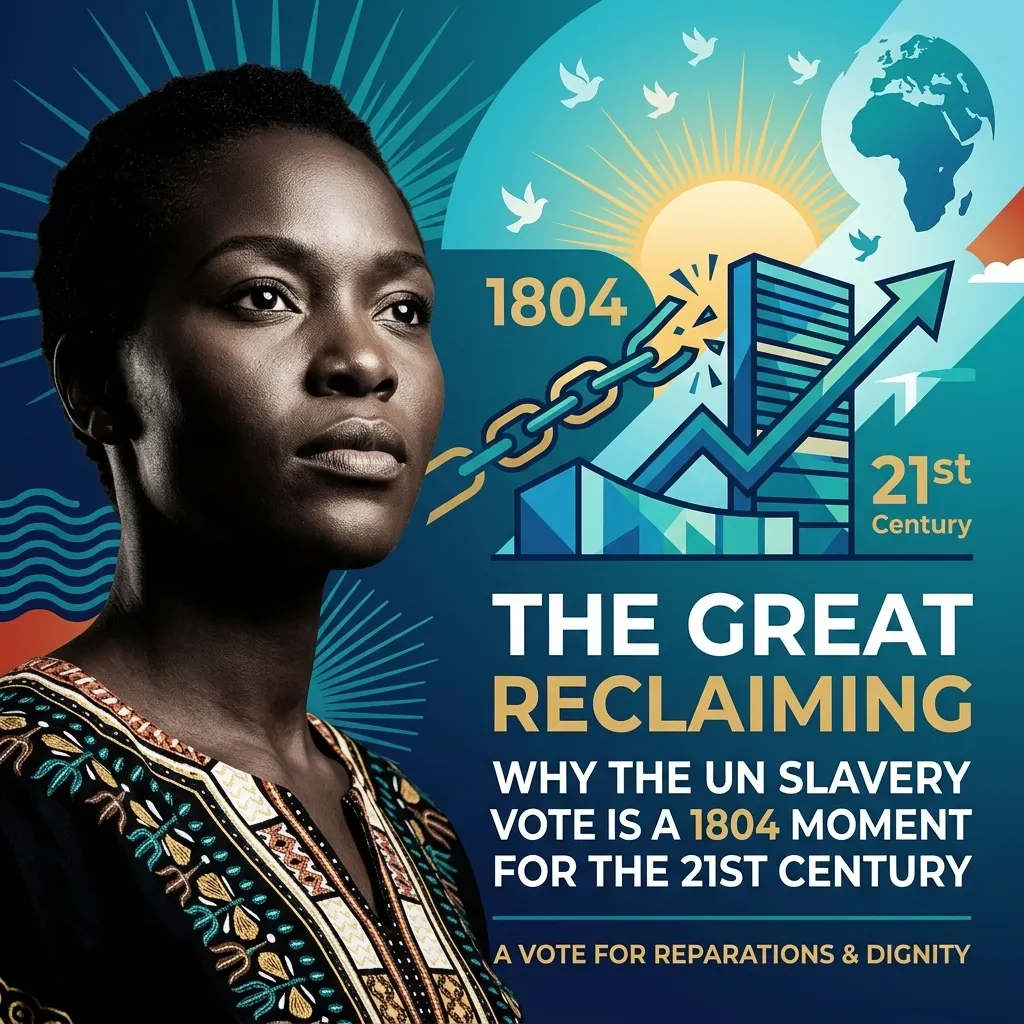
It was a 1804 moment for the 21st century.
To understand the weight of this vote, we have to look back at Haiti.
In 1804, the enslaved didn't just ask for freedom; they took it.
They shattered the myth of European invincibility.
They broke the physical chains that bound their hands.
But as we’ve learned in the two centuries since, breaking the physical chain is only the first half of the battle.
The second half is much harder.
The second half happens inside the skull.
This UN resolution, pushed forward by a "United Front" of the African Union and CARICOM, is the modern continuation of that Haitian defiance.
It is the global majority deciding that the era of asking for recognition is over.
We are now in the era of demanding restitution.

The vote count tells a story of two different worlds.
On one side, the Global South stood united.
Africa, the Caribbean, and much of Latin America and Asia voted "Yes."
They voted for truth.
On the other side, we saw the familiar silhouettes of the old Global Power Systems.
The United States. The United Kingdom.
They abstained or voted "No."
They spoke of "procedural concerns" and "legal complexities."
But let’s be real.
They were protecting a legacy.
They were protecting a narrative that allows them to benefit from the past without paying for it in the present.
When we talk about decolonization meaning, we are talking about more than just flags and anthems.
We are talking about the dismantling of the structures that allow the beneficiaries of a crime to remain the judges of its punishment.
The refusal of the West to join this consensus shows us exactly where the work remains.
It shows us that internalized colonialism isn't just something individuals struggle with; it is baked into the DNA of international diplomacy.
One of the most radical parts of this resolution isn’t about money.
It’s about artifacts.
The call for the "Restitution of Cultural Artifacts" is a call for the return of stolen souls.
When a bronze from Benin or a sacred carving from the Kongo sits in a temperature-controlled room in London or Paris, it isn't "art."
It is a prisoner of war.
These objects were the physical manifestations of our ancestors' genius, their spirituality, and their history.
To hold them captive is to continue the act of theft.
Barbados Ambassador David Comissiong called this a "watershed" moment.
He’s right.
Returning these artifacts is an essential step in the decolonization of the mind.
It is about the "Restitution of Memory."
It is about looking at our history not through the lens of what was taken, but through the lens of what was created despite the theft.
We cannot fully decolonize your mind if our ancestral symbols are still behind glass in the capitals of our former colonizers.

We often talk about the colonial mentality as a relic of the past.
It isn’t.
It is the quiet voice that tells us that Western validation is the only validation that matters.
It is the feeling that our systems of knowledge are "primitive" and theirs are "universal."
This UN vote is a massive blow to that voice.
By declaring the slave trade the gravest crime against humanity, the world is finally aligning its moral compass with the lived reality of millions.
But the vote is just the beginning.
Reparatory justice isn't just a check in the mail.
It is the systemic undoing of the damage.
It is fixing the healthcare systems that fail Black mothers.
It is fixing the economic systems that keep the Global South in debt.
It is fixing the education systems that teach us to admire our oppressors and ignore our heroes.
In my book, Alike Regardless: This Is Where It Began, I explore the roots of how we perceive ourselves and each other.
We have to understand where the "fracture" started to know how to heal it.
The "gravest crime" didn't just steal labor; it attempted to steal our sense of human unity.
It tried to convince us that we were fundamentally different: unequal.
To move forward, we must engage in the deep, often painful work of Decolonization of the Mind.
History is moving.
Can you feel the rhythm?
The courage to speak.
The courage to vote.
The courage to remember.
The old systems are trembling because they rely on our silence.
They rely on our collective amnesia.
But the African Union and CARICOM have decided to remember.
They have decided to lead.
This "United Front" is the fulfillment of the Pan-African dream.
It is the realization that our fates are intertwined.
From the streets of Bridgetown to the halls of Addis Ababa, the message is clear.
We are no longer waiting for permission to be whole.

The UN resolution is a mirror.
For the Global South, it reflects a face that is finally being seen.
For the West, it reflects a history that can no longer be ignored.
We must continue to push.
We must continue to ask the hard questions about global power systems.
Why is the "Restitution of Cultural Artifacts" still a debate and not a directive?
Why is the word "reparations" still treated like a threat instead of a necessity?
The 1804 Revolution was about the body.
This 2026 Resolution is about the soul.
It is about the agency to define our own future.
It is about the power to reclaim our own narrative.
Don't wait for the world to tell you who you are.
Decolonize your mind.
Reclaim your legacy.
The chains are falling.
It’s time to walk.
If you’re ready to dive deeper into the themes of identity, history, and the power of narrative, pick up a copy of my book, Alike Regardless: This Is Where It Began. It is a journey into the heart of what connects us and the systems that try to keep us apart.
For more on these shifts in global power, check out my thoughts on Redefining America and the Liberation of a Continent.

Listen, reflect, and join the conversation
Explore Haitian history, cultural pride, identity, mental liberation, and the beliefs that shape how we understand ourselves and the world.
Digital Media Platform & Talk Show
High-impact conversations redefining Haiti’s global narrative while connecting the Haitian diaspora with the homeland through history, cultural pride, and future innovation.

Podcast
Thought-provoking conversations examining inherited beliefs about faith, language, history, culture, education, identity, and human worth.

