
Digital Media Platform & Talk Show
1804 Renaissance
High-impact conversations redefining Haiti’s global narrative while connecting the Haitian diaspora with the homeland through history, cultural pride, and future innovation.

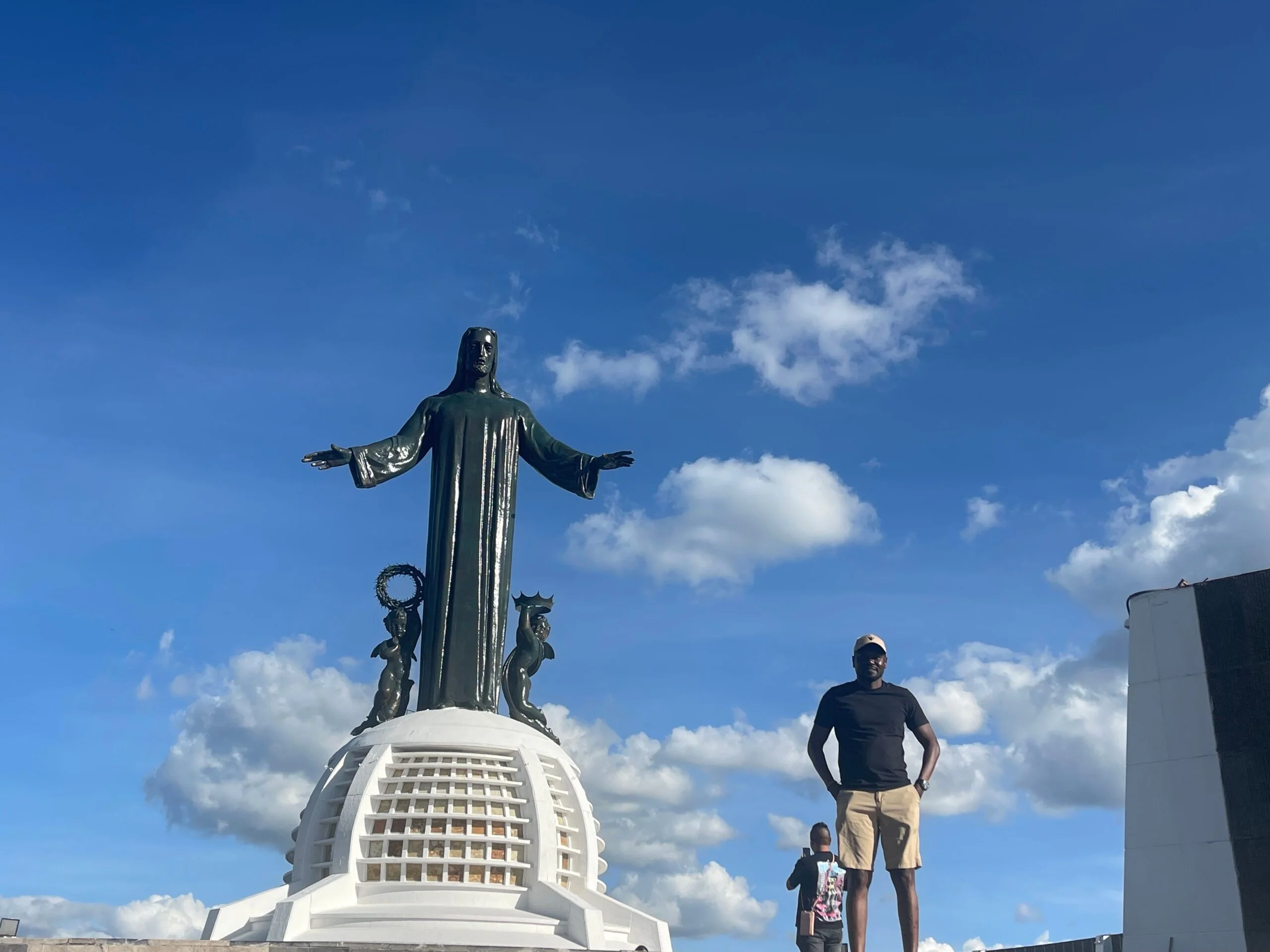
Cristo Rey at Cerro del Cubilete, Guanajuato, Mexico.
Category: Power, Systems & Colonial Structures
From Guanajuato to Dili, enormous Christ the King statues stand above cities, borders, and national histories. They are devotional monuments, but they also carry messages about authority, belonging, memory, and power. This essay asks what happens when a spiritual claim and a political claim become the same claim, and what it means when communities reclaim monuments first built to speak for someone else.
I recently stood at La Montaña Cristo Rey in Guanajuato, Mexico.
The climb up Cerro del Cubilete was physical before it became historical. The path rose toward the summit. The air changed. The noise thinned. The sky widened into a hard, uninterrupted blue.
Then the bronze figure appeared.
Not as an image on a page. Not as a distant landmark. As a body above the mountain.
The statue stood with its arms open, framed by the silence of the summit and the clouds moving behind it. Around the base, the monument gathered its own history: the figure of Christ, the angels, the hemispherical structure below.
I was looking upward.
Then I noticed the box.
It was a simple wooden slot marked: “OFRENDA PARA EL SANTÍSIMO.”
An offering for the Most Holy.
That small phrase opened the larger question. Who decides which transaction is faith and which is superstition?
A person leaves money in a church box and the act is named devotion. A person makes an offering within Vodou or an Indigenous tradition and the act is often described as transactional, primitive, or superstitious.
The gesture may be structurally similar.
The language surrounding it is not.

Offering box marked “Ofrenda para el Santísimo” at Cerro del Cubilete.
This is not an argument against Catholic practice. It is an argument against the unequal naming of practice.
Faith is never only what a person believes privately. It is also the institution that gives belief its authorised vocabulary. One offering becomes sacramentally meaningful. Another becomes evidence of backwardness.
The question is not whether people should give.
The question is who possesses the power to define what giving means.
That question follows the monument up the mountain.
The Cristo Rey statue belongs to a wider family of monumental Christs.
Rio de Janeiro’s Christ the Redeemer was completed in 1931 (see Encyclopaedia Britannica). The statue itself is about 30 metres high, standing on an eight-metre pedestal above Corcovado (Encyclopaedia Britannica).
Then came Cochabamba.
The Cristo de la Concordia, completed in Bolivia in 1994, was built deliberately taller than Rio’s monument (Atlas Obscura). The statue is commonly measured at 34.2 metres, with the full monument reaching about 40.44 metres (Atlas Obscura).
The difference is not accidental.
Size is a language.
A small statue asks for attention. A giant statue commands the horizon. It enters the eye before it enters the mind. It becomes part of the daily architecture of thought.
The body of the monument says: look here.
The height says: this matters.
The position says: this stands above.
Cochabamba’s name is important. Cristo de la Concordia means Christ of Concord, or Christ of Peace. The monument presents itself as a symbol of reconciliation and civic unity. Yet its deliberate surpassing of Rio also reveals another layer: even monuments of peace participate in a competition over visibility.
Who has the largest Christ?
Who occupies the skyline?
Who becomes the image through which a city imagines itself?
Rio’s Christ the Redeemer became a national symbol. Cochabamba answered with a larger figure. The gesture was devotional, civic, and comparative at the same time.
This is how authority often works.
It does not always announce itself through laws or armies. Sometimes it rises in concrete and bronze. Sometimes it asks to be understood as love while occupying the highest visual position in the landscape.
A monument can console the people beneath it.
It can also teach them where power belongs.
Cerro del Cubilete is not merely a convenient place to build.
It is the highest point in its region and is held to be at the geographic centre of Mexico (as described by Guanajuato State Tourism and related site histories of Cubilete). That matters because high ground has always carried sacred meaning.
Before colonial Christianity, many societies understood mountains, hills, and elevated places as locations where the human and spiritual worlds met. Height suggested nearness. It marked a threshold between ordinary life and the realm of the ancestors, gods, or unseen forces.
Colonial religion did not simply arrive with a new set of beliefs.
It entered an already sacred geography.
Churches were frequently built over or beside Indigenous temples and shrines. In Cusco, the Church of Santo Domingo was built over the Inca Qorikancha, the Temple of the Sun (UNESCO, City of Cuzco). In Mexico and elsewhere, Catholic structures occupied older ceremonial spaces, reused their stones, and redirected established routes of pilgrimage.
This was practical.
It was also political.
To build over a temple is to make a claim about succession. The new structure says that the old sacred order has been defeated, absorbed, or placed beneath another authority.
The hilltop Christ continues this language in a different form.
The statue does not need to destroy an older temple to make a spatial claim. Its elevation already speaks. The sacred is now represented above the region, above the ordinary settlements, above the field of daily life.
But the history is not complete if we describe this only as replacement.
People carried older understandings of sacred space into the new religious forms. Indigenous communities did not simply become empty vessels for European Christianity. They adapted, translated, resisted, and reshaped what had been imposed on them.
This is why a decolonisation of the mind must examine both domination and survival.
The colonised did not merely receive meaning.
They made meaning under pressure.
The mountain remembers both facts.
The story of Cerro del Cubilete is not a simple tale of oppressor and oppressed.
The original monument was dynamited on 30 January 1928 on the orders of President Plutarco Elías Calles, during the Cristero War (see Cerro del Cubilete and the historical overview in México Desconocido).
Calles’s government enforced the anticlerical provisions of the Mexican Constitution with particular severity (Encyclopaedia Britannica, “Cristero uprisings”). Religious institutions were restricted. Clergy were regulated. Public Catholic life was placed under state pressure (Encyclopaedia Britannica, “Cristero uprisings”).
The Cristeros rose against that pressure.
They were largely poor, rural, Indigenous, and mestizo Mexicans (Encyclopedia.com, “Cristero Rebellion”; Encyclopaedia Britannica, “Cristero uprisings”). Many were defending a religious world that was not abstract to them. It shaped their families, communities, rituals, moral life, and understanding of belonging.
They were not simply defending an institution from a distance.
They were defending what they understood to be theirs.
That matters.
It is easy to turn the Cristero War into a neat political diagram: revolutionary state on one side, Church on the other; secular modernity against religious reaction. But history is more fractured than that.
The conflict involved faith, land, local authority, poverty, class, ethnicity, state violence, and competing visions of Mexico. Religious devotion was central, but it existed within material struggles that could not be separated from it.
Poor people fought for the Church.
That fact should not be erased merely because the Church was also an institution with power.
Nor should the institution’s power erase the dignity of the people who defended their faith.
The present Cristo Rey statue was created by the sculptor Fidias Elizondo and inaugurated on 11 December 1950 (as cited in monument histories gathered in México Desconocido and related Cubilete references). It stands on a hemispherical base symbolising the universe (México Desconocido). Eight columns support the structure, representing Mexico’s religious provinces at the time (México Desconocido).
The design gathers several messages into one form.
Christ stands above the universe.
The provinces support the monument.
The nation appears unified through a shared act of devotion.
The statue also carries the memory of destruction. The monument was blown up by a government that wanted to restrict religious authority. Its reconstruction became an answer written in bronze.
The state had tried to remove the symbol.
The faithful rebuilt it.
That is not the same as saying every political use of the symbol is innocent. It is to recognise that ordinary people can inhabit a monument differently from the institutions that sponsor it.
The statue is a memorial to conflict.
It is also a monument to endurance.
Across the Tagus from Lisbon stands Cristo Rei in Almada.
The Portuguese bishops vowed in 1940 to build the monument if Portugal remained neutral in the Second World War (Visit Portugal; Santuário de Cristo Rei history). Portugal did not enter the war as a combatant, and the vow was fulfilled.
Cristo Rei was inaugurated in 1959 under the Estado Novo dictatorship of António de Oliveira Salazar (Visit Portugal; Santuário de Cristo Rei history).
The monument was dedicated to the “social reign of Christ” (Santuário de Cristo Rei history).
That phrase deserves attention.
It does not describe only private devotion. It imagines Christ’s authority extending across society: its laws, institutions, moral order, and public identity.
The monument therefore belonged to both religious and political language.
It stood for gratitude.
It stood for national protection.
It stood for a Catholic conception of public life that the dictatorship used to reinforce its authority.
Two years after the monument was inaugurated, Portugal’s colonial wars in Africa began (the wars are conventionally dated from 1961 in standard histories of late Portuguese empire).
The sequence is difficult to ignore. A monument dedicated to Christ’s social reign appeared under an authoritarian regime that presented Portugal as a protected Catholic nation. Soon afterward, that same regime began fighting to preserve its colonial possessions.
The contradiction is not a reason to mock the devotion of Portuguese Catholics.
It is a reason to examine how easily spiritual language can sanctify political power.
A nation may describe itself as protected while inflicting violence elsewhere.
A state may speak of peace while defending an empire.
A monument may face the city with open arms while the government behind it closes its fist.
The body of Christ remains visible.
The bodies subjected to colonial rule are pushed outside the frame.
Cristo Rei in Dili presents an even sharper tension.
The statue was commissioned by Indonesian President Suharto and unveiled on 15 October 1996, during Indonesia’s occupation of East Timor (Timor-Leste Tourism; see also Cristo Rei of Dili).
It was 27 metres high (Timor-Leste Tourism; Cristo Rei of Dili).
The number was chosen to represent East Timor as Indonesia’s 27th province (Cristo Rei of Dili).
The symbolism was deliberate. The statue was reportedly positioned facing Jakarta (Cape Fatucama; Cristo Rei of Dili). It was presented as a gift to the largely Catholic population of Timor Timur, as East Timor was then called (Timor-Leste Tourism).
But a gift can carry a political demand.
The monument was condemned as propaganda by resistance leader Xanana Gusmão and by Bishop Carlos Filipe Ximenes Belo (Cristo Rei of Dili; for Belo’s wider role, see Encyclopaedia Britannica). Its religious form was being used to support a claim of political integration that many Timorese rejected.
This is the central question: do you demolish the coloniser’s monument or repurpose it?
Timor-Leste kept Cristo Rei after independence in 2002 (Cristo Rei of Dili; Timor-Leste Tourism).
That decision changed the meaning of the statue without changing its concrete or height. A monument built to announce Indonesian authority became part of the landscape of an independent Timor-Leste.
The colonised embraced what had been built to dominate them.
That act can be read as contradiction.
It can also be read as reclamation.
The statue no longer belongs entirely to the intention of the person who commissioned it. Communities can interrupt the meaning imposed upon them. They can take a symbol designed to speak for power and make it speak to survival, faith, memory, or nationhood.
This is not forgetfulness.
To keep the monument is not necessarily to forgive the occupation. To visit it is not necessarily to endorse Suharto. To pray beneath it is not necessarily to accept the story Jakarta wanted to tell.
A people can inherit an object without inheriting its original politics.
That is one of the quiet forms of liberation.
Cristo Rey is not only a name placed on monuments.
It is a theological and political title.
Pope Pius XI instituted the Feast of Christ the King in 1925 through the encyclical Quas Primas. The feast responded directly to secularism, revolutionary nationalism, and the growing claim that modern states could define public life without reference to religious authority (Vatican archive, Quas Primas).
Pius XI’s argument was not confined to the private soul.
Christ, in this framework, was king over individuals, families, societies, and nations.
The title announces sovereignty.
The New Testament passage most often connected to this authority is Matthew 28:18–20. Christ says: “All authority in heaven and on earth has been given to me.” He then commands his followers to “make disciples of all nations.” (Bible Gateway, Matthew 28:18–20).
The sequence matters.
Authority and mission arrive in the same sentence.
The claim is first cosmic: all authority.
The claim is then geographic: all nations.
That does not settle how every Christian should understand the passage. It does reveal why the text can become politically powerful. A spiritual claim can move outward into education, law, culture, public morality, and the organisation of society.
The same words can comfort the persecuted.
They can also be used by institutions seeking influence over the governed.
This is why language must be examined before it is inherited.
The phrase “Christ the King” can mean refuge to someone whose state has attacked their faith. It can mean dignity to a people who have endured persecution. It can also be used to make a nation’s political order appear divinely authorised.
The meaning is never secured by the title alone.
It depends on who speaks it, who benefits from it, and who is expected to submit.
That is the work of a decolonised mind: not rejecting every inherited symbol, but refusing to receive any symbol without asking what it has been made to do.
The statues are not the problem.
Devotion is not the problem.
The person who climbs the mountain, kneels before the figure, lights a candle, or places an offering in a box is not the problem.
Faith can be a shelter.
Faith can be memory.
Faith can be the language through which a wounded people refuse to disappear.
The problem begins when a spiritual claim and a political claim become the same claim.
Then the faithful pay for it.
They pay in money, when devotion is turned into an institutional economy without accountability.
They pay in silence, when questioning authority is treated as betrayal.
They pay in fear, when a tradition teaches them to fear their own ancestors, languages, ceremonies, or ways of understanding the sacred.
They pay in memory, when the monument is allowed to tell only one side of the story.
A Cristo Rey statue may represent love to one person, survival to another, national pride to another, and political domination to someone else.
All of those meanings can exist at once.
The task is not to flatten them.
The task is to learn how they were made.
The empire on the hill is not always an empire of armies. Sometimes it is an empire of categories. It names one form of devotion holy and another superstitious. It places one tradition at the centre and another at the margins. It teaches the mind which ancestors deserve reverence and which must be forgotten.
But monuments can be reclaimed.
Language can be reclaimed.
Memory can be reclaimed.
A people can stand beneath a structure built by power and ask a different question from the one power intended.
Not, “What must we believe?”
But, “Who taught us to believe it this way?”
That question is not an attack on faith.
It is an act of responsibility.
The future belongs to those willing to examine the structures inside the mind before they attempt to rebuild the world outside it.
We do not have to destroy every inherited symbol.
We do have to refuse inherited submission.
We have to read the mountain, the statue, the box, and the silence.
We have to reclaim the mind.
Then we can rewrite the future.
These questions also continue through Who Taught You That?, a space for examining the stories that shape identity, faith, history, and power.
The same questions inform my book Alike Regardless: This Is Where It Began, a reflection on unity, love, and the work of confronting what divides us.
Receive the first two chapters free. Visit yvenerduroseau.com or text COLONIZATION to +1 318-667-8226.
Listen, reflect, and join the conversation
Explore Haitian history, cultural pride, identity, mental liberation, and the beliefs that shape how we understand ourselves and the world.
Digital Media Platform & Talk Show
High-impact conversations redefining Haiti’s global narrative while connecting the Haitian diaspora with the homeland through history, cultural pride, and future innovation.

Podcast
Thought-provoking conversations examining inherited beliefs about faith, language, history, culture, education, identity, and human worth.

