
Digital Media Platform & Talk Show
1804 Renaissance
High-impact conversations redefining Haiti’s global narrative while connecting the Haitian diaspora with the homeland through history, cultural pride, and future innovation.

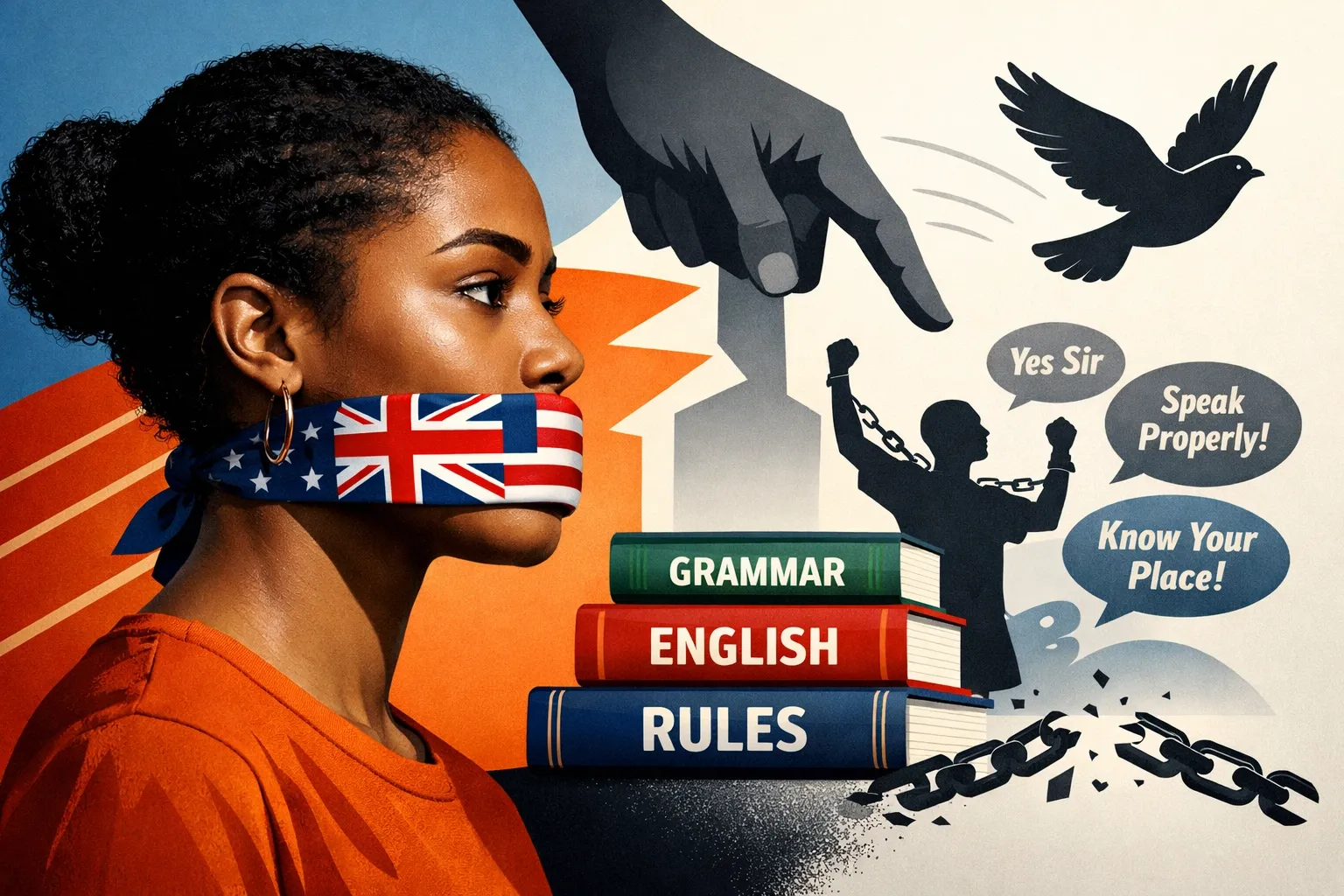
Category: Language, Culture & Power
What does it mean to own your breath?
For many of us, the very air we push through our vocal cords is filtered through a sieve of colonial history.
We speak, but the sounds we make are often judged by a standard that was never meant to liberate us.
We are taught that "proper" language is the gateway to intelligence.
We are taught that our mother tongues are "dialects" or "slang."
This is not an accident of linguistics.
This is a design of empire.
The tongue is the first frontier of colonization.
Before the land is seized, the mind must be convinced of its own inadequacy.
The most effective way to do this is to take away the language of the home and replace it with the language of the master.
In the Haitian context, this tension is visceral.
French is the language of the salon, the court, and the cathedral.
Kreyòl is the language of the market, the street, and the soul.
One was historically used to command.
The other was built to resist.

Language is more than a tool for communication.
It is a repository of culture.
It is a map of a people’s journey through time.
When a colonial power imposes its language, it isn’t just teaching new words.
It is erasing old memories.
It is forcing the colonized to view themselves through the eyes of the colonizer.
Ngũgĩ wa Thiong'o, in his seminal work Decolonising the Mind, captures this perfectly:
"Language, any language, has a dual character: it is both a means of communication and a carrier of culture."
He argues that the "cultural bomb" is the biggest weapon used by imperialism.
The effect of this bomb is to annihilate a people’s belief in their names, in their languages, and in their environment.
It makes them see their past as a wasteland of non-achievement.
It makes them want to distance themselves from that wasteland.
This is the psychological weight of the "colonizer’s tongue."
It is a heavy, golden chain.
It promises status while demanding the surrender of identity.
I explore the roots of this fractured identity in my book, Alike Regardless: This Is Where It Began.
We have to understand where the fracture started to know how to heal it.
The healing begins in the mouth.
We have been conditioned to associate certain accents with authority.
We hear a European lilt and we assume expertise.
We hear the rhythmic, staccato pulse of the Caribbean and we assume "informality."
This hierarchy is a ghost of the plantation.
It is the lingering scent of a system that equated "civilization" with Western European standards.
In Haiti, the battle between French and Kreyòl has long been a class struggle.
To speak French fluently was to be "educated."
To speak only Kreyòl was to be "unrefined."
But who defines refinement?
Who decided that the language of the 1804 Revolution: the language that whispered the plans for freedom in the dark of the night: was inferior?
The colonizer’s tongue was used to draft the codes of slavery.
The people’s tongue was used to break them.

The danger of the colonizer’s tongue is that we eventually start to police ourselves.
We feel a twinge of shame when we "slip" into our native cadence in professional settings.
We prioritize English or French literature over the oral traditions of our ancestors.
We teach our children to master the master’s language before they can speak their own truth.
This is what I call the internal architecture of belief.
It is a structure built on the assumption that we are inherently lacking.
But we are not lacking.
We are simply translated.
In Alike Regardless: This Is Where It Began, I talk about the importance of recognizing our shared humanity beyond these constructed barriers.
If we are to achieve true mental sovereignty, we must stop asking for permission to speak.
We must stop treating our culture as a hobby and start treating it as a foundation.
The decolonization of the mind: a theme I will be exploring deeply in my future work: requires a radical re-evaluation of how we value ourselves.
It requires the courage to be "unrefined" by their standards.
The courage to be authentic by our own.
Unlearning the language of inferiority is not about abandoning English or French.
It is about stripping them of their power to define our worth.
It is about realizing that fluency in a colonial language is a skill, not a measure of humanity.
We can use their tools to build our own houses.
But we must never forget whose house we are in.
When we speak Kreyòl, we are honoring the ancestors who refused to be silenced.
When we embrace our history, we are reclaiming the narrative power that was stolen from us.
The 1804 Renaissance is not just about a date in history.
It is about a state of mind.
It is about the refusal to be small.
It is about the audacity to speak truth to power in the language of the heart.

The work of decolonization is quiet, but it is urgent.
It happens in the way we talk to our children.
It happens in the books we choose to read.
It happens in the moment we decide that we no longer need to sound "white" to be heard.
We are entering an era where the old hierarchies are crumbling.
The world is beginning to realize that the "civilization" offered by the West was often just a mask for extraction.
As we peel back that mask, we find the vibrant, resilient, and brilliant cultures that were suppressed.
We find ourselves.
If you are looking for a roadmap to this reclamation, start with the history of the struggle.
Pick up Alike Regardless: This Is Where It Began.
Understand the systems that tried to silence you.
Then, find your voice.
Speak it loud.
Speak it proud.
Speak it in the tongue that makes your ancestors smile.
The chain is broken the moment you realize it was never actually there.
The only thing holding the tongue is the mind.
And the mind belongs to you.

We do not need to seek validation from the empire.
The empire is a relic.
We are the future.
Our languages are not "broken" versions of theirs.
They are complete, complex, and beautiful expressions of our survival.
To unlearn inferiority is to realize that you were never inferior to begin with.
You were just being told a lie in a very fancy accent.
It is time to stop listening to the lie.
It is time to start speaking the truth.
The 1804 Renaissance is calling.
Will you answer in your own voice?
For more reflections on identity, power, and the journey toward mental sovereignty, explore Alike Regardless: This Is Where It Began by Yvener Duroseau.

Listen, reflect, and join the conversation
Explore Haitian history, cultural pride, identity, mental liberation, and the beliefs that shape how we understand ourselves and the world.
Digital Media Platform & Talk Show
High-impact conversations redefining Haiti’s global narrative while connecting the Haitian diaspora with the homeland through history, cultural pride, and future innovation.

Podcast
Thought-provoking conversations examining inherited beliefs about faith, language, history, culture, education, identity, and human worth.

