
Digital Media Platform & Talk Show
1804 Renaissance
High-impact conversations redefining Haiti’s global narrative while connecting the Haitian diaspora with the homeland through history, cultural pride, and future innovation.

Category: Decolonization of the Mind
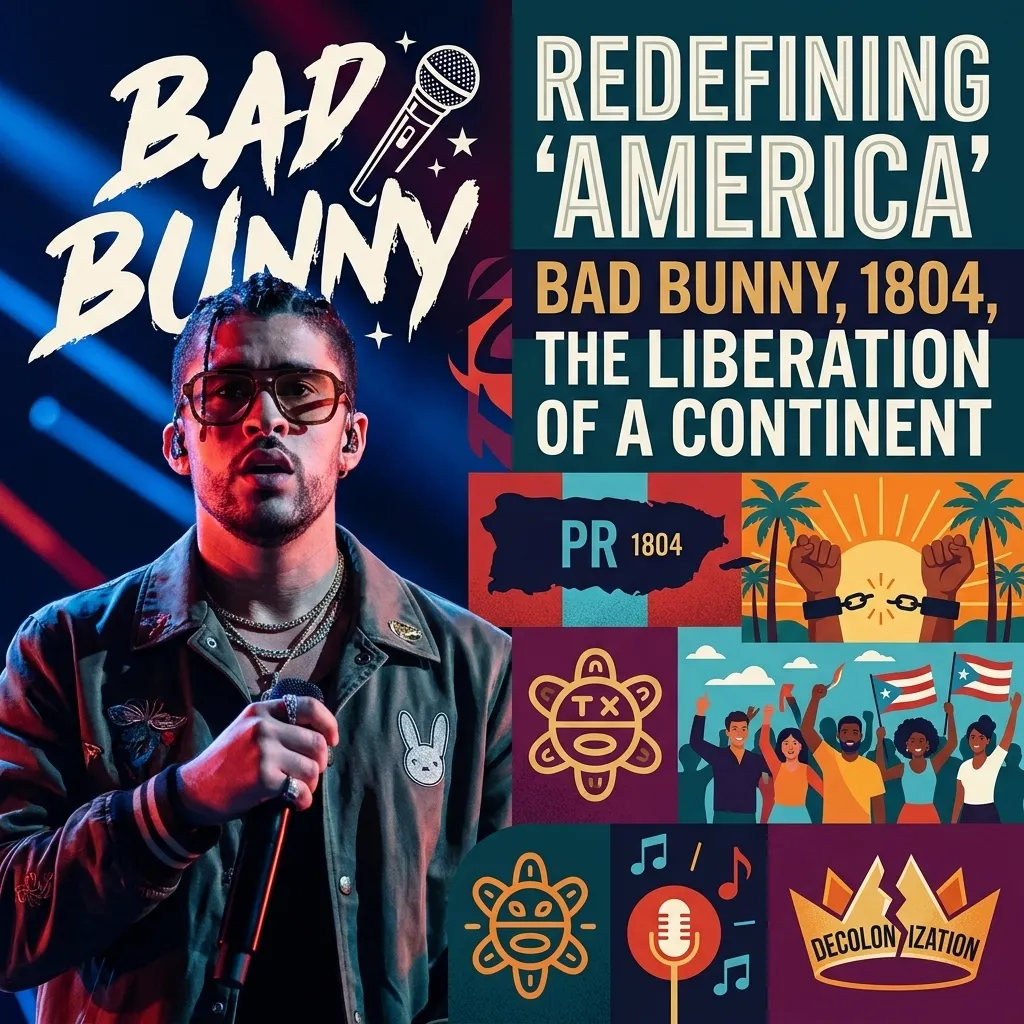
The lights of the Super Bowl stage were blinding.
The world was watching.
Bad Bunny stood at the center of the spectacle, holding a football.
It was a quiet moment in a loud night.
The ball bore a simple, defiant inscription: "Together, we are America."
Then, he shouted it.
"God bless America."
For the casual observer, it sounded like a standard patriotic platitude.
For those of us awake to the nuances of history, it was a subversive act of linguistic reclamation.
He didn't just mean the United States.
He meant the whole thing.
He meant the north, the south, the central, and the islands.
He meant the soil that was tilled by the enslaved and the indigenous long before a border was ever drawn.
This was not a "crossover" moment.
Bad Bunny did not translate himself for the masses.
He brought his culture, his language, and his history to the stage and demanded the world meet him there.
This is the very essence of the decolonization meaning.
It is the refusal to be minimized by a map.
We live in a world where the word "America" has been hijacked.
It has been narrowed down from a vast, vibrant continent to a single political entity.
This is not an accident of language.
This is a calculated byproduct of internalized colonialism.
When we say "America," we are taught to see one flag.
We are taught to ignore the millions of people in Mexico City, Bogota, Port-au-Prince, and Buenos Aires who share this name.
As noted in recent reports by The Independent, there is a growing, righteous frustration across the continent.
People are tired of having their identity erased by a linguistic monopoly.
They are tired of being told they are "from the Americas" but are not "American."
This erasure is a tool of power.
It creates a hierarchy of belonging.
It suggests that some are the owners of the name, while others are merely guests in the periphery.
To decolonize your mind, you must first learn to see the map for what it really is.

To understand the liberation of a continent, we must look to the Caribbean.
We must look to 1804.
The Haitian Revolution was not just a local uprising.
It was the first true American act of total decolonization.
It was the moment the "New World" stopped being a playground for European empires and started being a home for liberated souls.
Haiti provided the blueprint for the entire continent.
It gave the world the courage to imagine a life outside of the colonial framework.
The courage to fight.
The courage to win.
The courage to exist on its own terms.
When Bad Bunny speaks of a "United America," he is channeling the spirit of 1804.
He is reminding us that our liberation is linked.
If one part of the continent is still mentally shackled, we are all restricted.
We must move past the colonial mentality that views our neighbors as "others."
We must recognize that the pulse of the continent began in the mountains of Haiti and moved through the veins of every person seeking freedom.
This isn't just a pop culture moment.
It is a continuation of a long intellectual struggle.
José Martí, the Cuban visionary, wrote "Nuestra América" (Our America) over a century ago.
He warned against the "giant in seven-league boots" that sought to consume the identity of its neighbors.
Martí argued that we cannot govern ourselves if we do not know ourselves.
He believed that the salvation of the continent lay in embracing its unique, diverse roots.
Similarly, scholars like Aníbal Quijano and Immanuel Wallerstein developed the concept of "Americanity."
They argued that the very idea of "America" was born out of coloniality: a system of social classification based on race and labor.
This system was designed to benefit the few at the expense of the many.
It created a world where a passport or a skin color dictates your worthiness to be called "American."
But the reality is far more complex.
The reality is visceral.
Everyone on this continent contributes to the fabric of what the world calls the USA.
The labor, the art, the language, and the spirit of the entire continent are woven into the very flag people think they are defending when they exclude others.

We are often told that to succeed, we must blend in.
We are told to soften our accents.
To hide our history.
To adopt the "colonizer’s tongue" to gain access to the rooms of power.
But look at the stage again.
Bad Bunny did not speak English to be understood.
He spoke his truth to be felt.
This is the work of mental liberation.
It is the act of standing in your power without asking for permission.
In my book, Alike Regardless: This Is Where It Began, I explore how our narratives have been fractured by external forces.
We have been conditioned to see ourselves through the eyes of our oppressors.
We have been taught that our value is tied to our proximity to Whiteness or Western ideals.
The courage to remember our true origins.
The courage to reject the labels imposed upon us.
The courage to redefine our own destiny.
This is what it means to decolonize the mind.
It is an internal landscape that must be reclaimed inch by inch.
What does it mean to be American?
Is it a piece of paper issued by a government?
Is it the ability to pass through a border without suspicion?
Or is it something deeper?
America is a shared experience of survival and creation.
It is the collective energy of millions who refuse to be forgotten.
It is the grandmother in Mexico City who keeps the ancient stories alive.
It is the worker in Florida who builds the skyline.
It is the scholar in Haiti who reminds us of our revolutionary heart.
When we limit "America" to the borders of the United States, we are participating in our own mental imprisonment.
We are accepting a smaller version of ourselves.
We are validating the internalized colonialism that tells us we are less than.

The statement "God bless America" should not be a prayer for one nation.
It should be a recognition of a whole people.
A people who have survived genocide, slavery, and systemic exclusion.
A people who continue to rise.
We must stop seeking validation from systems that were never built for us.
We must stop translating our souls for the comfort of the status quo.
The work of decolonization of the mind starts with the language we use and the stories we tell.
It starts with acknowledging that 1804 was the beginning of our collective freedom.
It starts with seeing the beauty in our "untranslated" selves.
God bless the America that remembers its roots.
God bless the America that refuses to be divided by a border.
God bless the America that is all of us.
This is where it begins.
This is how we heal.
This is how we reclaim the continent.
To dive deeper into the roots of these narratives and the power of reclaiming your history, grab your copy of Alike Regardless: This Is Where It Began.
Mental liberation is not a destination; it is a practice.
Let us practice together.


Listen, reflect, and join the conversation
Explore Haitian history, cultural pride, identity, mental liberation, and the beliefs that shape how we understand ourselves and the world.
Digital Media Platform & Talk Show
High-impact conversations redefining Haiti’s global narrative while connecting the Haitian diaspora with the homeland through history, cultural pride, and future innovation.

Podcast
Thought-provoking conversations examining inherited beliefs about faith, language, history, culture, education, identity, and human worth.

