
Digital Media Platform & Talk Show
1804 Renaissance
High-impact conversations redefining Haiti’s global narrative while connecting the Haitian diaspora with the homeland through history, cultural pride, and future innovation.

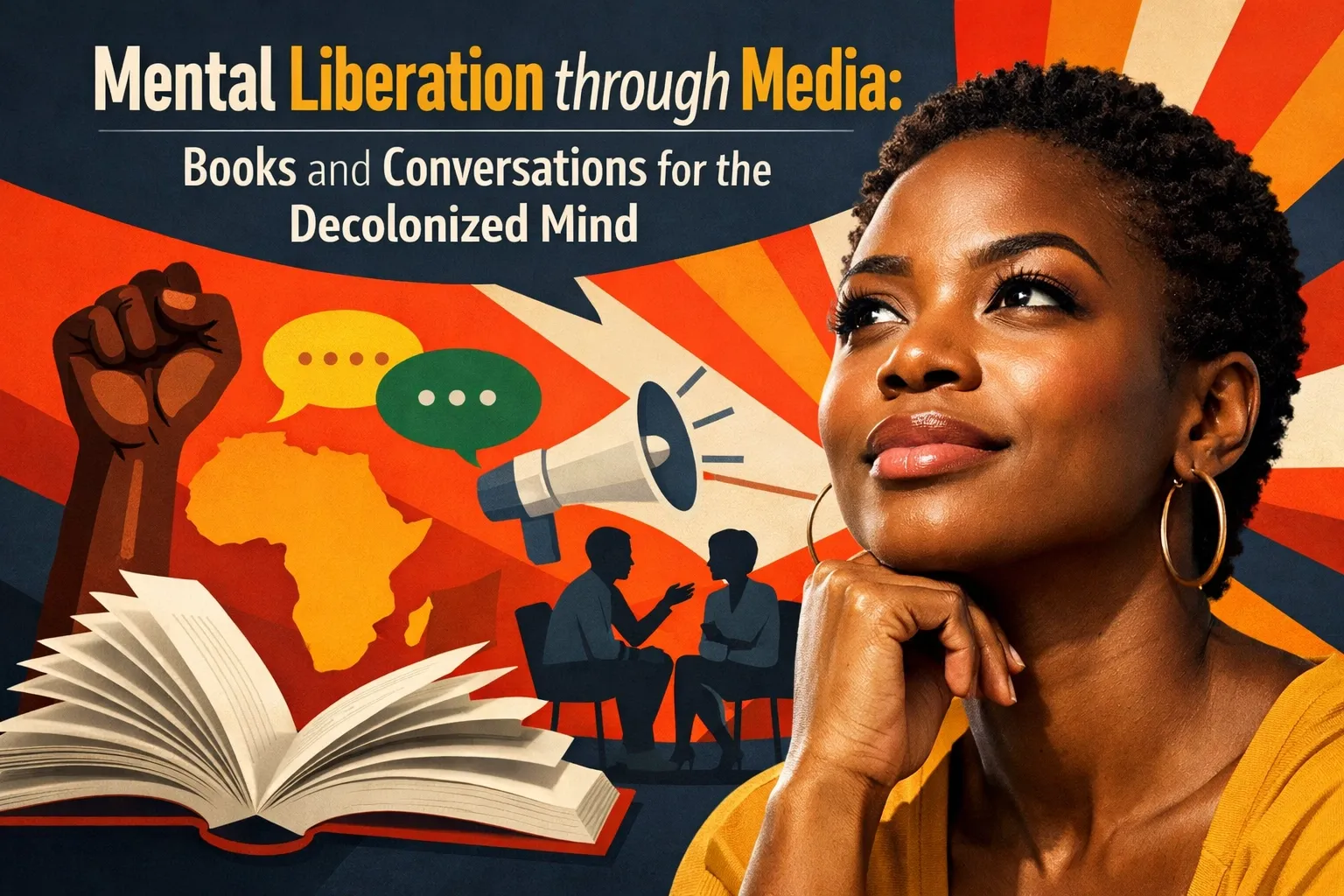
Do you ever stop to wonder who owns the landscape of your imagination?
We wake up every morning and step into a reality we did not design.
We consume narratives that were written long before we were born.
We repeat phrases, celebrate holidays, and uphold values that often serve a system designed to keep us small.
This is the invisible architecture of the colonized mind.
To decolonize your mind is not an act of academic vanity.
It is an act of survival.
It is the process of unlearning the "normalized" distortions that have been sanctified by time.
It is the labor of sifting through the noise of modern media to find the signal of your own soul.
If we want to be free, we must first look at what we are reading, what we are watching, and what we are saying to one another.
Colonization did not end when the flags were lowered and the soldiers went home.
It simply moved indoors.
It moved into the classroom.
It moved into the pulpit.
It moved into the ink of the textbooks.
Ngũgĩ wa Thiong'o, the brilliant Kenyan writer, famously spoke of the "colony of the mind."
He argued that the most dangerous form of control is the one that is almost invisible.
When you control a person’s language, you control their perception of the world.
When you teach a child that European literature like Shakespeare or Chaucer is the only standard of "civilization," you teach them to see their own heritage as a footnote.
You teach them to admire the architect of their own cage.
We have been socialized to process our existence through a lens that was never meant to capture our brilliance.

Think about the media you consume today.
Is it healing you, or is it reinforcing a fractured identity?
Much of our modern media is a mirror that reflects a distorted image of our humanity.
It tells us that our history began in chains.
It tells us that our worth is tied to our productivity.
It tells us that we must compete, rather than collaborate.
This internalization of colonial values creates a deep psychological wound.
We learn not to process pain, but to endure it.
We learn not to ask questions, but to follow scripts.
We have become experts at performing roles that were written by people who never saw us as equal.
To truly decolonize your mind, you must begin to recognize these scripts in real-time.
You must develop the courage to pause.
The courage to doubt.
The courage to rewrite.
Books are not just objects; they are vessels for mental liberation.
They allow us to enter conversations with ancestors we never met and thinkers who refused to be broken.
In my book, Alike Regardless: This Is Where It Began, I explore the fundamental truth of our shared humanity, stripped of the labels imposed upon us.
It is a call to look past the divisions that have been manufactured to keep us apart.
When we read works that challenge the status quo, we begin to repair the connections that were severed by colonial education.
We find ourselves in the radical pedagogy of Paulo Freire, who urged us to develop a "critical consciousness."
We find ourselves in the raw, clinical analysis of Frantz Fanon, who diagnosed the psychic trauma of the oppressed.
These authors do not just provide information.
They provide a mirror that finally reflects our true faces.

We cannot talk about liberation without talking about 1804.
Haiti’s revolution was not just a physical battle; it was a psychological explosion.
It was the ultimate rejection of the colonial narrative.
The revolutionaries did not just want to change their masters; they wanted to abolish the concept of mastery itself.
They understood that you cannot build a free society on the foundation of a colonized mind.
They reclaimed their dignity through fire and through faith.
Today, we must apply that same revolutionary spirit to our media consumption.
We must be as radical with our bookshelves as they were with their bayonets.
We must refuse to consume media that dehumanizes the "other" or sanctifies the oppressor.
We must seek out stories that ground us in the wisdom of our ancestry rather than the anxieties of our current systems.
The work of liberation is ongoing.
It is a daily practice of choosing what we allow to take root in our consciousness.
The concept of "Decolonization of the Mind" is more than just a phrase; it is the central theme of my upcoming intellectual focus.
It is about moving beyond the "fractured" self and toward a unified understanding of our power.
We are entering an era where the old stories are no longer enough to sustain us.
The media of the past is failing to explain the complexities of our present.
We need a new language.
We need new metaphors.
We need conversations that do not stop at the surface but dive into the depths of our belief systems.

How do we start?
We start by changing the questions we ask in our circles.
Instead of asking, "What is the news saying?" we ask, "Whose interest does this narrative serve?"
Instead of asking, "How do I fit in?" we ask, "Why was this space built to exclude me?"
Mental liberation happens in the quiet moments of reflection and the loud moments of community dialogue.
It happens when we stop apologizing for our truth.
It happens when we realize that the "civilization" we were told to aspire to is often just a sophisticated form of control.
We must cultivate the courage to be "un-socialized."
The courage to be "un-educated" by the systems that failed us.
The courage to be "re-born" through our own storytelling.
The goal is not to replace one dogma with another.
The goal is to reach a state of intellectual sovereignty.
A state where you are the primary author of your own life.
When we decolonize our minds, we stop seeking permission to exist.
We stop waiting for the media to validate our worth.
We recognize that our value is inherent, ancestral, and unshakeable.
This is the path toward true human unity.
Not a unity based on forced assimilation, but a unity based on mutual respect and the recognition of our shared origin.
We are alike, regardless of the borders and brackets that have been drawn around us.

Your mind is a sanctuary.
Do not let it become a marketplace for colonial ideas.
Fill it with books that challenge you.
Surround yourself with conversations that expand you.
Engage with media that honors the complexity of the human spirit.
The chains are heavy, but they are made of paper.
You have the power to tear them down, one page at a time.
For more reflections on leadership, history, and the path to mental freedom, visit https://xtj.ezb.mybluehost.me/website_d9c927d6.
The journey of unlearning is the greatest adventure of your life.
Take the first step.
Reclaim your mind.
The world is waiting for the version of you that is truly free.
Learn more about the beginning of this journey at https://yvenerduroseau.com/home.

Listen, reflect, and join the conversation
Explore Haitian history, cultural pride, identity, mental liberation, and the beliefs that shape how we understand ourselves and the world.
Digital Media Platform & Talk Show
High-impact conversations redefining Haiti’s global narrative while connecting the Haitian diaspora with the homeland through history, cultural pride, and future innovation.

Podcast
Thought-provoking conversations examining inherited beliefs about faith, language, history, culture, education, identity, and human worth.

