
Digital Media Platform & Talk Show
1804 Renaissance
High-impact conversations redefining Haiti’s global narrative while connecting the Haitian diaspora with the homeland through history, cultural pride, and future innovation.

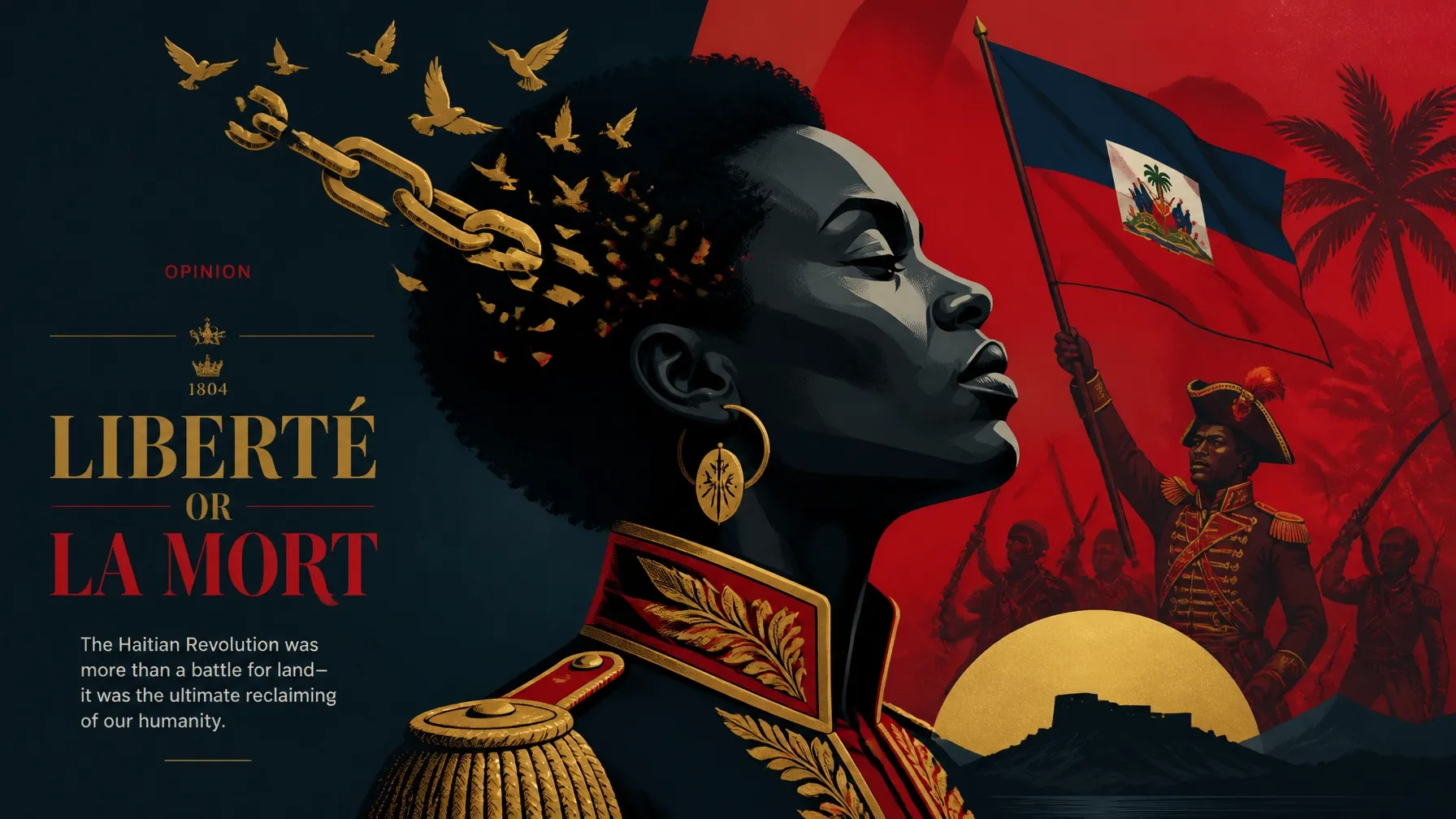
Category: History & Narrative Power
This essay contrasts sanitized European historical accounts with the undeniable, radical reality of the Haitian Revolution. By examining how Eurocentric framing attempts to minimize 1804, we uncover a blueprint for breaking free from inherited colonial paradigms. Ultimately, reclaiming this history is not merely an academic exercise, but an essential act of mental liberation.
We inherit the stories that keep us small.
We are handed histories edited by the victors. We are taught to revere revolutions that compromised with human bondage while dismissing the one revolution that demanded total, uncompromising human dignity.
This is no accident.
It is the architecture of a colonial mentality.
To understand why 1804 terrifies traditional power structures, we must first confront the chasm between sanitized European narratives and the raw, unvarnished haitian revolution facts. Saint-Domingue was once the jewel of the French colonial empire. It was built on unimaginable human suffering, driven by the blood and sweat of enslaved Africans trapped in a regime of unprecedented brutality.
Europeans built their Enlightenment on the backs of the enslaved.

They wrote grand treatises on liberty while chaining human beings to sugar cane stalks. They celebrated human rights while denying humanity to millions.
Then came 1804.
The silence that followed was deafening. As Haitian historian Michel-Rolph Trouillot famously observed in Silencing the Past: Power and the Production of History, the Haitian Revolution entered history as "unthinkable even as it happened." European powers could not comprehend that enslaved Africans would not only demand freedom, but systematically dismantle the invincible military machines of France, Britain, and Spain to claim it.
The courage to imagine a world without masters. The courage to turn weapons of oppression into instruments of absolute liberation. The courage to forge a sovereign republic from the ashes of a plantation.
That was 1804.
Yet, for over two centuries, European narratives have labored to erase this triumph. They rebranded it as chaos. They marginalized it as an exception. They punished Haiti with crippling economic embargoes and diplomatic isolation, and then had the audacity to point to the resulting financial strain as proof of self-governing incapacity.
This is the psychological trick of colonial power.
It creates the wound and then blames the victim for bleeding.
As C.L.R. James wrote in The Black Jacobins, "The transformation of slaves, trembling in hundreds on a single plantation, into a people able to organize themselves and defeat the most powerful European nations of their day, is one of the great epics of revolutionary struggle." Yet this epic is routinely pushed to the margins of Western education.
Why? Because acknowledging the truth of 1804 requires dismantling the comforting myth that liberty was a European gift handed down to the world. It exposes liberty as something that had to be seized, fought for, and defended against the entire Western world.

This suppression of history is precisely why the decolonization of the mind remains our most urgent modern imperative.
We carry invisible chains. We measure our worth through the language of our colonizers. We view our cultures, our spirituality, and our potential through lenses ground in European capitals.
We accept the framework that places us at the bottom of a global racial hierarchy.
Breaking these mental chains requires intellectual bravery. It requires us to look past the sanitized textbooks and interrogate the foundational myths we have internalized.
Not to process pain, but to master it. Not to dwell in grievance, but to reclaim our agency.
When we study the Haitian Revolution with clear eyes, we realize that freedom is not an abstract philosophical debate. It is a physical, spiritual, and psychological reclamation. It is the realization that no system: no matter how entrenched, no matter how heavily armed: is permanent.
The colonizer's greatest victory is convincing the colonized that resistance is impossible.
The Haitian Revolution shattered that illusion forever.

Healing our collective psyche requires returning to this foundational source of revolutionary power. It requires recognizing that our struggles today: whether against systemic inequality, cultural erasure, or the subtle traps of modern neo-colonialism: are intimately connected to the battles fought in the valleys of Saint-Domingue.
We must learn to look at one another not through the fractured categories assigned by colonial powers, but through the profound truth of our shared humanity. This journey toward self-definition and mutual recognition is explored deeply in my book Alike Regardless: This Is Where It Began, which invites readers to move past artificial divisions and discover unity through love and deep self-reflection.
The work of mental liberation begins the moment we stop accepting inherited narratives as absolute truth.
It begins when we refuse to apologize for our existence.
It begins when we remember that 1804 was not an isolated historical anomaly, but the blueprint for human emancipation.
The chains are heavy.
The programming is deep.
Yet the legacy of 1804 whispers across the centuries with undeniable clarity: We were never meant to be owned. We were never meant to be small.

We carry the blood of those who rewrote the world.
It is time to rewrite our minds.

Upcoming book by Yvener Duroseau
A thought-provoking examination of the inherited beliefs, systems, histories, and invisible forces that shape how we understand faith, language, identity, culture, power, and human worth.
Release date: May 18, 2027
Begin the reflection with a free preview of the book.

Listen, reflect, and join the conversation
Explore Haitian history, cultural pride, identity, mental liberation, and the beliefs that shape how we understand ourselves and the world.
Digital Media Platform & Talk Show
High-impact conversations redefining Haiti’s global narrative while connecting the Haitian diaspora with the homeland through history, cultural pride, and future innovation.

Podcast
Thought-provoking conversations examining inherited beliefs about faith, language, history, culture, education, identity, and human worth.
