
Digital Media Platform & Talk Show
1804 Renaissance
High-impact conversations redefining Haiti’s global narrative while connecting the Haitian diaspora with the homeland through history, cultural pride, and future innovation.

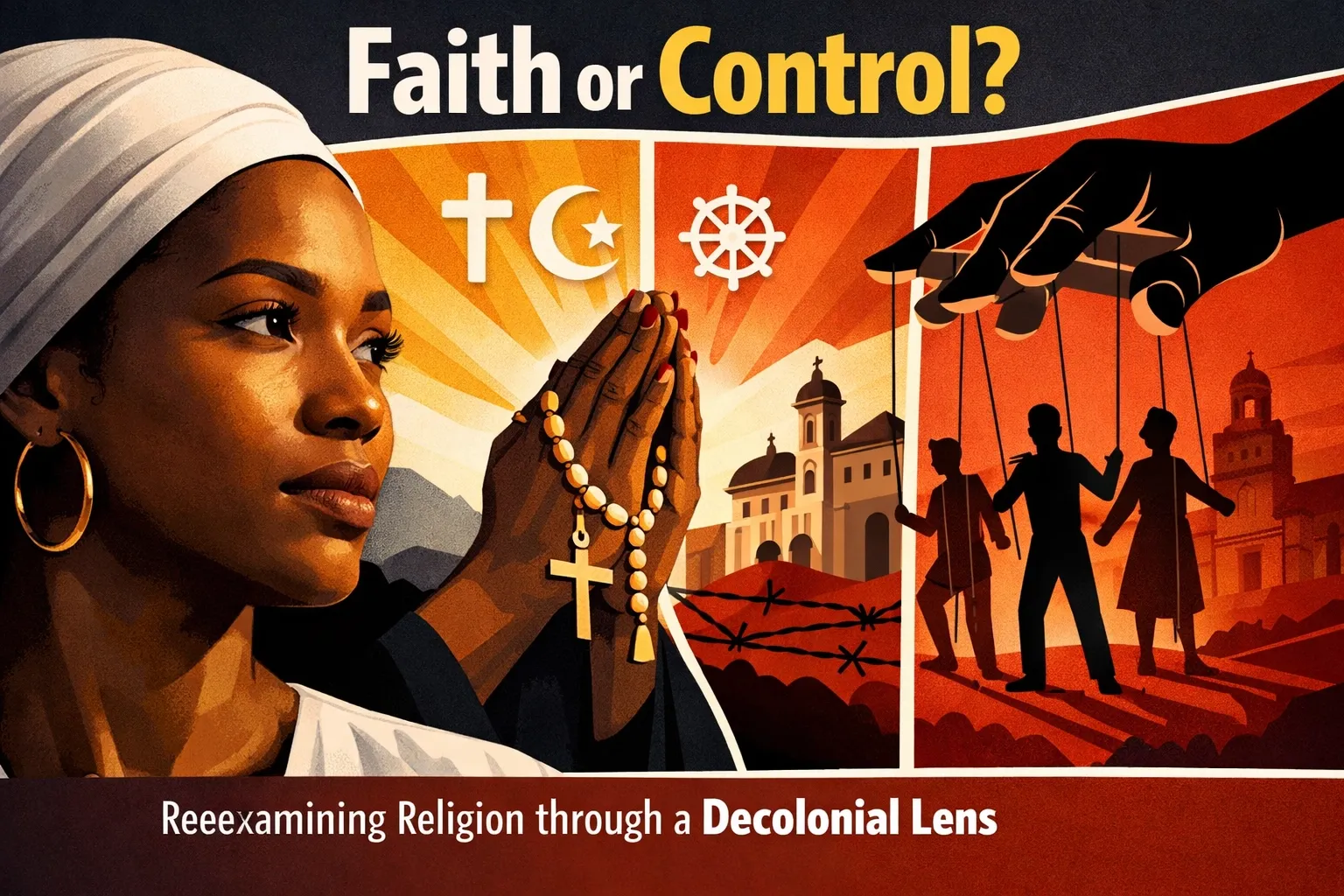
Did you choose your God?
Or was He chosen for you long before you were born, by men who did not look like you?
This is a question we often bury under layers of tradition, ritual, and Sunday morning comfort. We treat our spiritual identity as an immutable fact of our existence, as natural as the blood in our veins. But for those of us navigating the wreckage of post-colonial societies, faith is rarely a simple matter of the heart.
It is a matter of history.
It is a matter of power.
It is a matter of survival.
To examine religion through a decolonial lens is not to attack the Divine. It is to audit the delivery system. It is to ask why the "Good News" so often arrived on the same ships as the chains. It is to confront the reality that for centuries, the pulpit was used to sanctify the plantation.
The category of "religion" was never a neutral term.
In the colonial project, it was a weapon of classification. European frameworks were positioned as the universal standard of truth. Everything else: the ancestral whispers of the African continent, the earth-centered cosmologies of the Caribbean, the relational wisdom of the indigenous: was labeled as "pagan," "demonic," or "primitive."
This was not an accident.
It was a dispositive of the coloniality of power.
By defining the colonizer as the sole custodian of the spiritual, the colonial machine justified its dominion. If your soul is "dark," you need a "light-bearer" to rule over you. If your traditions are "chaos," you need Western "order" to save you.

We were taught that to be holy was to be Western.
We were taught that to be spiritual was to renounce the self.
Not to find God, but to find a master.
This is where the colonial mentality takes root: not in the laws of the land, but in the prayers of the people. It is a fractured state of being where we look at our own history and see only sin, while looking at our oppressors’ history and seeing only providence.
The most effective cage is the one you cannot see.
Internalized colonialism is the quiet voice that tells you that your ancestral language is unfit for prayer. It is the reflexive shudder you feel when you hear the beating of a drum instead of the swelling of an organ. It is the belief that God only speaks through the aesthetics of the conqueror.
The courage to question.
The courage to deconstruct.
The courage to reclaim.
We have been conditioned to believe that questioning the structure of our religious institutions is the same as questioning God. It is not. In fact, it may be the most sacred act of all. To strip away the colonial varnish is to reveal the grain of the original wood.
Many of us operate under a theology that prioritizes endurance over liberation. We were given a version of faith designed to make us "good" subjects, not free humans. We were taught to value the "afterlife" so much that we became indifferent to the injustices of this life.
Not to process pain, but to endure it.
Not to challenge the system, but to pray for the strength to survive it.
This is the psychological residue of a faith used as an anesthetic. It numbs the mind to the reality of its own subjugation. It sanctifies the status quo.
Haitian history provides us with a different blueprint.
In 1804, the revolution was not just a political rupture. It was a spiritual insurrection. It was the moment when a people decided that their humanity was more sacred than the laws of their masters. It was the realization that mental liberation must precede physical freedom.

When we look back at our history, we see a constant tension between the religion imposed upon us and the faith that rose from within us. We see a people who took the symbols of their oppressors and infused them with their own meanings, their own struggles, and their own revolutionary fire.
This is the work I explore in my book, Alike Regardless: This Is Where It Began. It is about understanding the roots of our identity and the common threads that bind us despite the divisions imposed by colonial structures. To move forward, we must understand exactly where the fracture began.
We cannot talk about human unity if we are still operating under a hierarchy of the soul.
True faith should be a mirror, not a mask.
It should reflect your inherent worth, not hide your perceived "deficiencies."
The upcoming work on Decolonization of the Mind is centered on this very transformation. It is about the intellectual bravery required to look at our inherited traditions and ask: "Does this serve my liberation, or does it maintain my control?"
Decolonizing our belief systems means recovering the marginalized voices of our past. It means recognizing that the Divine is not a European export. It means understanding that the "universal" claims of colonial theology were often just the local prejudices of a few powerful men.
It is a process of reclaiming the sacredness of our own bodies, our own land, and our own memory.

We are moving away from a theology of dominion and toward a theology of relationality.
We are moving away from a faith of fear and toward a faith of power.
This is not a comfortable journey. It requires us to sit in the silence of our own doubts. It requires us to face the normalized traumas that we have rebranded as "devotion." But on the other side of that discomfort is a spiritual clarity that no colonial structure can provide.
Faith is meant to be the wind beneath the wings of human potential.
If your faith feels like a weight, it is likely because it was designed to hold you down.
Control wears many robes. Sometimes it wears the robe of the law; sometimes it wears the robe of the priest. Our task is to recognize the difference between the message and the medium.
We must have the audacity to believe that the Creator did not require a middleman from a foreign land to speak to our hearts. We must have the strength to decolonize our altars before we can truly decolonize our lives.
The chains are off.
Now, we must decide what to do with the mind.
Mental liberation is not a destination. It is a daily practice of choosing truth over tradition. It is the constant effort to ensure that our spiritual lives are built on a foundation of freedom, not a legacy of control.
Learn more about our journey toward mental liberation at yvenerduroseau.com

Listen, reflect, and join the conversation
Explore Haitian history, cultural pride, identity, mental liberation, and the beliefs that shape how we understand ourselves and the world.
Digital Media Platform & Talk Show
High-impact conversations redefining Haiti’s global narrative while connecting the Haitian diaspora with the homeland through history, cultural pride, and future innovation.

Podcast
Thought-provoking conversations examining inherited beliefs about faith, language, history, culture, education, identity, and human worth.

