
Digital Media Platform & Talk Show
1804 Renaissance
High-impact conversations redefining Haiti’s global narrative while connecting the Haitian diaspora with the homeland through history, cultural pride, and future innovation.

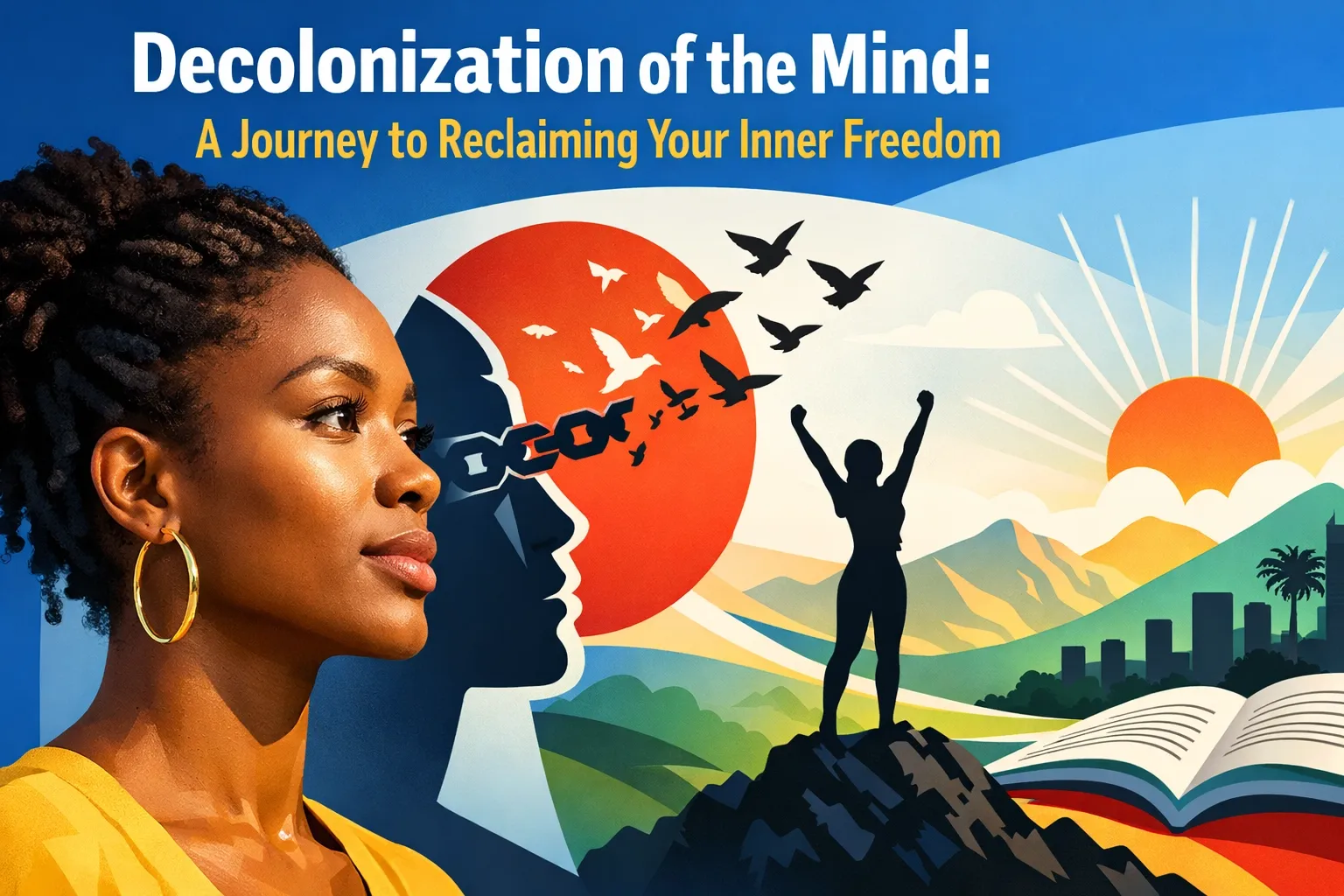
Whose voice do you hear when you are alone with your thoughts?
Is it truly yours?
Or is it a curated echo of a system designed to keep you small?
We live in a world where the chains have moved from the wrists to the psyche.
We are free, yet we are haunted.
To decolonize your mind is to perform a spiritual audit of everything you have been taught to believe.
It is a journey of reclaiming a self that was buried under layers of inherited shame and imported logic.
It is the most radical act of rebellion available to the modern human.
History tells us that revolutions happen on battlefields.
In 1804, the people of Haiti proved that the impossible was achievable.
They broke the physical machinery of empire.
They declared themselves human in a world that sought to categorize them as property.
But 1804 was a beginning, not a destination.
The physical liberation was swift; the mental liberation is a marathon that spans generations.
We inherited the victory, but we also inherited the trauma.
We inherited a world that still looks to the West for the definition of "civilized."
We inherited a hierarchy of skin, a hierarchy of hair, and a hierarchy of holiness.
To decolonize your mind is to realize that the revolution of 1804 is still happening inside of you.
It is to recognize that the colonial project did not end with a treaty.
It simply changed its medium.
It moved from the plantation to the textbook.
It moved from the law books to the prayer books.

We have been conditioned to fear our own power.
We have been taught to view our ancestral traditions through a lens of "superstition" while sanctifying the traditions of our oppressors.
This is not an accident.
This is the internal architecture of colonialism.
It functions by making the colonized person feel like a stranger in their own skin.
It creates a fracture in the soul.
You see it when we privilege English over our mother tongues.
You see it when we equate wealth with wisdom and poverty with a lack of character.
You see it when we struggle to imagine a future that isn't shaped by capital and competition.
The courage to look in the mirror and see a masterpiece.
The courage to speak the truth even when it lacks a professional accent.
The courage to trust your intuition over an institution.
We have normalized our own erasure.
We have internalized the idea that to be "successful" is to be as close to the colonial ideal as possible.
But success without self-knowledge is just a more comfortable cage.
Language is the carrier of culture.
When we are forced to speak only the language of the empire, we are forced to dream the empire’s dreams.
Ngũgĩ wa Thiong'o reminded us that language is the collective memory bank of a people.
To lose your language is to lose your map to the past.
But decolonization is not just about the words we speak; it is about the God we serve.
For centuries, religion was used as a tool to pacify the restless.
It was used to tell the oppressed that their suffering was a divine test.
It was used to replace the vibrant, earth-centered spirituality of our ancestors with a distant, judgmental deity.
To decolonize your mind is to reclaim the sacred.
It is to find the divine in the rhythm of the drum and the silence of the forest.
It is to understand that you do not need a middleman to speak to the Creator.
It is to reject any faith that requires you to hate yourself to love your God.

We are often told that our differences are our divisions.
We are told that we are separate, fragmented, and competing for a seat at a table that wasn't built for us.
In my book, Alike Regardless: This Is Where It Began, I explore the fundamental truth that lies beneath these artificial layers.
We are more alike than we are allowed to believe.
The systems that colonize our minds rely on us staying divided.
They rely on the "othering" of our neighbors.
They thrive on the fear of the stranger.
When you decolonize your mind, you begin to see through the illusions of borders and biases.
You begin to recognize the shared pulse of humanity.
You realize that your liberation is inextricably tied to the liberation of everyone else.
Not to process pain, but to endure it.
Not to seek justice, but to seek order.
We must reject these colonial binaries.
True freedom is the ability to define yourself on your own terms.
Decolonization of the mind is not a destination you reach and then stop.
It is a practice.
It is a daily unlearning.
It is a commitment to questioning the "common sense" of a world that is fundamentally nonsensical.
As I look toward my upcoming work, Decolonization of the Mind, I am struck by how urgent this conversation has become.
We are at a crossroads in human history.
The old systems are crumbling, yet we still carry the blueprints in our heads.
We cannot build a new world with the tools of the old one.
We cannot achieve mental liberation using the logic of the jailer.
We must be brave enough to sit in the discomfort of the unknown.
We must be willing to grieve the versions of ourselves that were created for someone else's benefit.
The journey is visceral.
It is psychological.
It is essential.
You are not a broken version of a colonial ideal.
You are a complete and sovereign being.
Your mind is the final frontier of the revolution.
Reclaim it.
Own it.
Sanctify it.
The chains are gone.
Now, walk.
To dive deeper into the themes of human unity and the foundations of our shared history, pick up a copy of Alike Regardless: This Is Where It Began. Stay tuned for more reflections as we explore the forthcoming intellectual journey of Decolonization of the Mind.

Listen, reflect, and join the conversation
Explore Haitian history, cultural pride, identity, mental liberation, and the beliefs that shape how we understand ourselves and the world.
Digital Media Platform & Talk Show
High-impact conversations redefining Haiti’s global narrative while connecting the Haitian diaspora with the homeland through history, cultural pride, and future innovation.

Podcast
Thought-provoking conversations examining inherited beliefs about faith, language, history, culture, education, identity, and human worth.

