
Digital Media Platform & Talk Show
1804 Renaissance
High-impact conversations redefining Haiti’s global narrative while connecting the Haitian diaspora with the homeland through history, cultural pride, and future innovation.

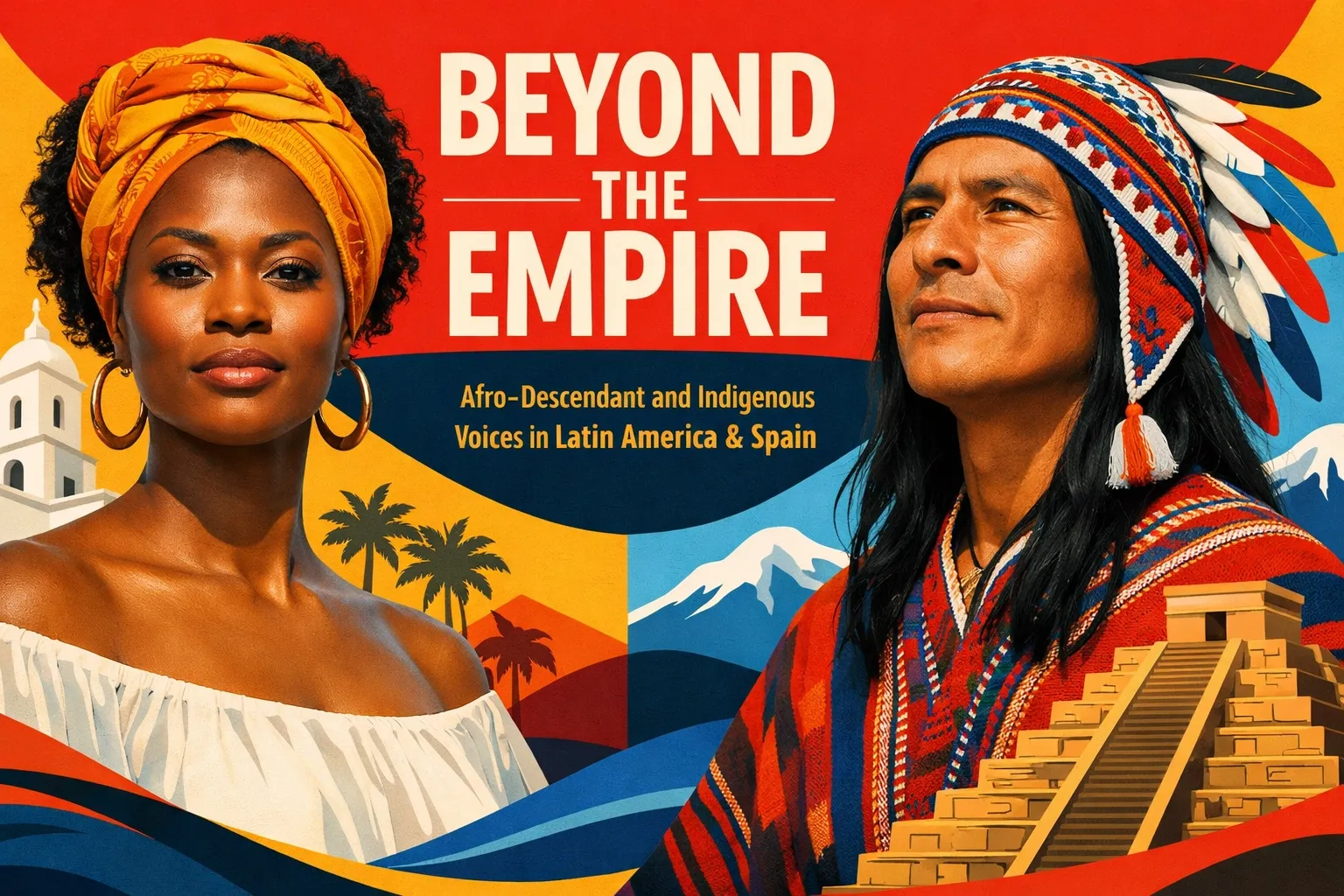
Category: Decolonial Thought in Latin America and Spain
Who owns the map of your identity?
We are often taught to define ourselves by the borders drawn by those who never knew our names.
In the vast expanse of what we call “Latin America,” the very language used to describe the land is a ghost of a Mediterranean empire.
“Latin.”
It is a prefix that centers Rome, France, and Spain while pushing the Andes and the Yoruba spirit to the periphery.
To speak of decolonial thought is not merely to recount history.
It is to perform surgery on the soul.
It is to ask why the “Motherland” is always located across an ocean and never beneath our feet.
For the Indigenous communities of the Americas and the Afro-descendant souls scattered by the winds of the Middle Passage, colonization is not a finished chapter in a textbook.
It is a living, breathing architecture of the mind.
Colonization is more than the theft of gold; it is the theft of the “I.”
When the Spanish Crown touched the soil of the Caribbean, the encounter was framed as a discovery.
But you cannot discover a house that is already full of people.
You can only invade it.
The erasure began with the Taino, the Mexica, and the Inca: civilizations that understood the cosmos long before the caravel ships appeared on the horizon.
Their voices were muffled under the weight of the cross and the sword.
Then came the silence of the hold.
The millions of African voices brought to the shores of Brazil, Colombia, and the Caribbean were stripped of their lineage and rebranded as labor.
We must realize that the “Latin American” identity was forged in a furnace of exclusion.
It was designed to prioritize the Mestizo: the mixed: only as a transition toward the white.
It was a systematic attempt to bleach the collective memory.

We often look at the Americas when we discuss decolonization, but we must also look at Spain.
Spain is a land haunted by its own history.
Today, the streets of Madrid and Barcelona are home to the children of the former colonies.
They are the “return” of the empire’s shadow.
Yet, the Afro-Spaniard and the Indigenous migrant often find themselves living in a state of ontological invisibility.
They are in the country, but not of it.
The colonial hierarchy remains intact in the way labor is distributed, in the way beauty is defined, and in the way the Spanish language is policed.
To be decolonial in Spain is to demand that the history of the 1492 “glory” be taught as a history of 1492 “rupture.”
It is to recognize that the wealth of the Spanish Golden Age was paved with the silver of Potosí and the blood of the enslaved.
We cannot heal a wound we refuse to look at.
The courage to look.
The courage to see.
The courage to unlearn.
The most dangerous borders are not made of barbed wire.
They are made of internalized beliefs.
We see it when a child is told that their Indigenous dialect is “incorrect” compared to Castilian Spanish.
We see it when an Afro-Latinx person feels the need to “fix” their hair to enter a boardroom.
These are the scars of a mind that has been colonized.
In my book, Alike Regardless: This Is Where It Began, I explore the fundamental truth that beneath these constructed layers of “otherness,” our humanity remains singular.
We have been conditioned to see the differences that the empire created, rather than the unity that the Creator intended.
The empire thrives on the “fractured” self.
It wants you to believe that you are a collection of categories rather than a whole being.
To decolonize the mind is to reclaim that wholeness.

Decolonization is not an academic theory; it is a daily practice.
It is a commitment to shifting your perspective until the world looks different.
1. Audit Your Narrative Consumption.
Look at your bookshelf and your playlist.
Whose stories are you consuming?
If your understanding of history comes only from the victors, your mind is still a colony.
Seek out Indigenous authors and Afro-descendant thinkers from the regions of Latin America.
Listen to the oral histories that were never meant to be written down.
2. Question the “Standards.”
When you use words like “civilized” or “professional,” ask yourself whose standards you are using.
Often, these words are codes for European cultural norms.
Reclaim the value of communal knowledge and ancestral wisdom.
3. Center the Voice, Not the Translation.
Stop waiting for Indigenous and Afro-descendant voices to be “validated” by Western institutions.
Their truth does not require a stamp of approval from a university in the Global North.
Value the lived experience as much as the peer-reviewed paper.
4. Language as Resistance.
If you speak Spanish, acknowledge its colonial roots.
Support the revitalization of Indigenous languages like Quechua, Nahuatl, or Kreyòl.
Understand that language is the vessel of culture; when a language dies, a way of seeing the world disappears.
The process is painful.
It requires us to admit that much of what we call “tradition” is actually “conditioning.”
Not to process pain, but to endure it.
This is the cycle we are here to break.
We are moving toward a future where the “Decolonization of the Mind” is not just a concept for a forthcoming book, but a lived reality for every person who has felt “less than” because of their origin.
This theme will be a recurring heartbeat in our conversations.
We will continue to peel back the layers of the Latin American identity to find the beating, Indigenous, and Afro-descendant heart beneath.
We will look at the systems that keep us divided and the faith that calls us back together.
The empire tried to bury us.
They forgot that we were seeds.

We are at a crossroads.
We can continue to worship at the altar of a history that does not love us, or we can build a new temple.
A temple built on the truth of who we were before the ships arrived.
A temple built on the resilience of those who survived the plantation.
A temple built on the unity found in Alike Regardless: This Is Where It Began.
True power is not the ability to rule others.
True power is the ability to define yourself.
Take back the pen.
Rewrite the map.
The empire is over.
The mind is finally coming home.

Listen, reflect, and join the conversation
Explore Haitian history, cultural pride, identity, mental liberation, and the beliefs that shape how we understand ourselves and the world.
Digital Media Platform & Talk Show
High-impact conversations redefining Haiti’s global narrative while connecting the Haitian diaspora with the homeland through history, cultural pride, and future innovation.

Podcast
Thought-provoking conversations examining inherited beliefs about faith, language, history, culture, education, identity, and human worth.

