
Digital Media Platform & Talk Show
1804 Renaissance
High-impact conversations redefining Haiti’s global narrative while connecting the Haitian diaspora with the homeland through history, cultural pride, and future innovation.

Category: Language, Culture & Power
A brief exchange at a Sogebank counter in Haiti reveals how colonial hierarchy survives inside ordinary acts of speech. Drawing on Chapter Three of The Colonization of the Mind: Breaking the Invisible Chains of Thought, this essay examines the difference between learning a colonial language for access and accepting the belief that one’s own language is inferior. It asks what happens when a people begin to apologize for the language that carried their memory.
What beliefs have we inherited, and who taught us to accept them as truth?
I carried that question with me in Haiti.
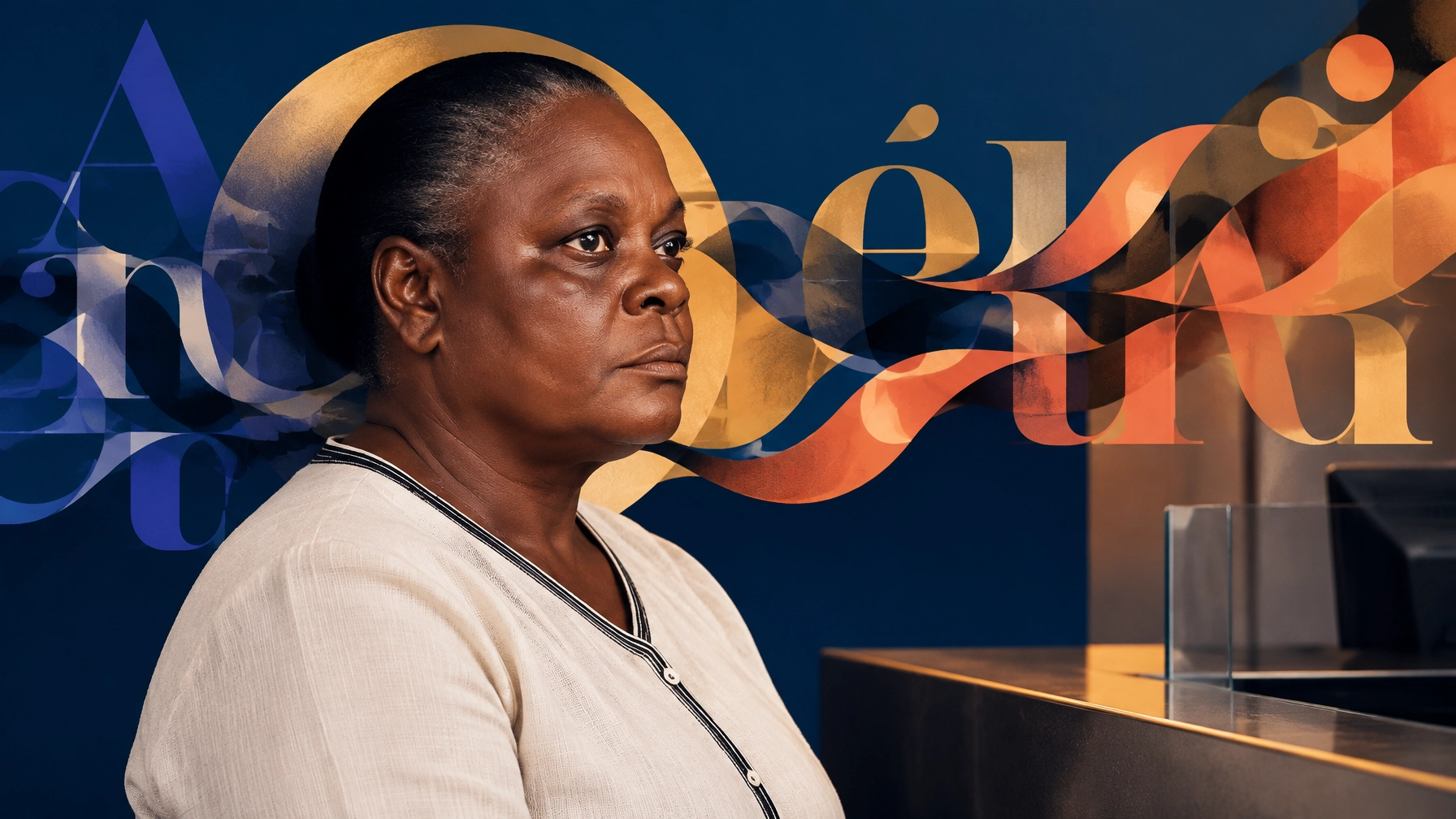
I was there with my nephew, Mitchi, standing at a Sogebank counter. The teller addressed us in French.
I understood her.
That was not the point.
She could speak Haitian Creole. She was Haitian. Yet she chose the colonial tongue in an ordinary institutional exchange, as if French were the language of courtesy, correctness, or competence.
As if Creole belonged elsewhere.
As if Creole belonged below.
The teller was likely not trying to insult us. She may have believed she was being professional. She may have believed she was being respectful. That is precisely what makes the moment so revealing.
A hierarchy can become so internalized that its enforcers no longer experience themselves as enforcing anything.
They experience themselves as behaving properly.
That is how power survives the departure of the powerful.

Colonialism does not end when the flag changes.
It remains in the nervous system.
It remains in the classroom, the church, the office, the bank, and the hesitation before a person speaks. It remains in the quiet calculation of which language will make us appear intelligent, respectable, educated, or safe.
French was not merely introduced as another language in Haiti.
It was positioned as a language of administration, authority, education, and elite legitimacy. Haitian Creole, despite being spoken by the overwhelming majority of Haitians, was repeatedly treated as informal, domestic, or insufficient.
This is not only a linguistic arrangement.
It is a psychological arrangement.
The language of the colonizer becomes associated with advancement. The language of the colonized becomes associated with intimacy, poverty, or limitation. A person may then learn to divide the self: one tongue for public life, another for the home; one voice for recognition, another for belonging.
The body learns the division.
The psyche memorizes it.
In Decolonising the Mind, Ngũgĩ wa Thiong’o writes that “language, any language, has a dual character: it is both a means of communication and a carrier of culture.” For Ngũgĩ, language does not simply transfer information. It carries history, values, memory, imagination, and a people’s relationship to the world.
To control a people’s language is therefore to influence how that people can imagine itself.
In the manuscript, I write: “But language is not just a tool of communication. It is a vessel of memory, of culture, of identity. When we abandon our languages, we abandon parts of ourselves.”
The loss is not always dramatic.
Sometimes it sounds like correction.
Sometimes it sounds like politeness.
Sometimes it sounds like a child being told that the language spoken by their grandmother is not suitable for serious conversation.
That is how shame becomes grammatical.
There is nothing inherently wrong with learning French, English, Spanish, or any other language.
Languages can open doors.
They can provide access to education, employment, diplomacy, literature, travel, and survival. Strategic bilingualism is not betrayal. It can be a form of agency.
The question is not whether we learn the language of power.
The question is whether we begin to believe that power has made the language superior.
There is a difference between using a language and kneeling before its hierarchy.
There is a difference between translation and submission.
There is a difference between access and assimilation.
Frantz Fanon explored this tension in Black Skin, White Masks. In Chapter One, “The Black Man and Language,” he writes, “To speak a language is to take on a world, a culture.” He also observes that “mastery of language affords remarkable power.”
Fanon’s argument is not that Black people should refuse to learn French. His concern is the unstable bargain colonial society offers: master the colonizer’s language and perhaps you will receive conditional acceptance. Speak correctly, and you may be treated as more intelligent. Sound French, and you may be treated as more human.
But the acceptance remains fragile.
It depends on performance.
It can be withdrawn.
The colonized person is invited to approach the center without ever being allowed to define it.

Haiti’s 1987 Constitution recognized Haitian Creole and French as the country’s official languages. Article 5 also identifies Creole as the common language uniting Haitians.
That recognition matters.
It establishes that Creole is not a lesser language awaiting permission to become legitimate. It is a language of national life, public identity, and collective belonging.
But constitutional recognition is not the same as complete transformation.
Institutional habits do not disappear because a legal text names a principle. Schools, government offices, courts, media organizations, and professional settings may continue reproducing older assumptions. The distance between what a constitution declares and what people experience remains unfinished work.
This distinction must be stated carefully.
The Constitution provides a formal framework. The persistence of French-dominant practices in some institutions is a matter of implementation, history, and social power, not proof that constitutional recognition has no value.
The law can affirm dignity.
Society must still learn to practice it.
That learning begins in the mind.
The Sogebank encounter remains with me because it was small.
Colonial power often appears in large historical events. It also appears in the small reflexes that no longer seem historical at all.
The reflex to switch languages.
The reflex to soften an accent.
The reflex to hide a mother tongue.
The reflex to assume that a foreign language carries more intelligence than the language of one’s own childhood.
These reflexes are not personal failures.
They are inherited conditions.
But inherited does not mean permanent.
We can learn another language without despising the one that formed us. We can move through institutions without allowing institutions to define our worth. We can speak French in one setting and Haitian Creole in another without treating one as elevated and the other as embarrassing.
The courage to learn.
The courage to remember.
The courage to refuse the hierarchy hidden inside our own politeness.
The courage to let our language stand without apology.

Language is not only what comes out of the mouth.
It is what the mind has been trained to honor.
It is what the body has been trained to conceal.
It is what memory continues to protect, even after power has instructed us to forget.
My first book, Alike Regardless: This Is Where It Began, reflects on the human unity that becomes possible when we confront the divisions we have inherited. That work begins with love and self-reflection. The forthcoming The Colonization of the Mind: Breaking the Invisible Chains of Thought, releasing May 18, 2027, asks us to examine the deeper structures that taught us what to fear, what to worship, what to speak, and what to silence.
The work is not to reject every language associated with colonial power.
The work is to reject the belief that our own language must be diminished for another language to matter.
Creole does not need to become French to become worthy.
The colonized tongue does not need to apologize for surviving.
Receive the first two chapters free. Visit https://book.yvenerduroseau.com/first-two-chapters or text COLONIZATION to +1 318-667-8226.

Listen, reflect, and join the conversation
Explore Haitian history, cultural pride, identity, mental liberation, and the beliefs that shape how we understand ourselves and the world.
Digital Media Platform & Talk Show
High-impact conversations redefining Haiti’s global narrative while connecting the Haitian diaspora with the homeland through history, cultural pride, and future innovation.

Podcast
Thought-provoking conversations examining inherited beliefs about faith, language, history, culture, education, identity, and human worth.

