
Digital Media Platform & Talk Show
1804 Renaissance
High-impact conversations redefining Haiti’s global narrative while connecting the Haitian diaspora with the homeland through history, cultural pride, and future innovation.


Category: Ancestry, Legacy & Memory
Overview: A memorial to Caribbean prisoners of war at Portchester Castle stood for five days before it went missing. The loss is under police investigation, and its motive has not been established. But the history it marked, and the community’s efforts to defend that memory, raise a question larger than the fate of one plaque: what does it mean to make a history visible, and what does it take to keep it that way?
Five days.
That is how long the plaque at Portchester Castle remained in place after its unveiling on 9 October 2026. It commemorated the 2,500 Caribbean people brought to Britain as prisoners of war in 1796. On 14 October, castle staff discovered it was missing. As of 26 October, it had not been found. (BBC News; University of Warwick)
The facts are stark. Their meaning is not yet settled.
Hampshire and Isle of Wight Constabulary is investigating the disappearance as a suspected theft, and police are treating it as suspected racially motivated. That is an allegation under investigation, not a proven motive. English Heritage’s Iona Keen called the removal vandalism and said it was bitterly disappointing. (Portsmouth News; BBC News)

A plaque is a small object. But the absence it leaves can feel large. It marks not only a wall, but the space between a history that happened and a history that people have been allowed to see.
In October 1796, more than 2,500 prisoners of war from the Caribbean arrived in Portsmouth Harbour after fighting connected to Britain’s capture of Fort Charlotte on St Lucia. Most were Black or of mixed race; some had been enslaved, while others were free. Almost all were held at Portchester Castle. (English Heritage, “Black prisoners of war at Portchester Castle”; University of Warwick)
The classification mattered. British commander Sir John Moore treated the captured soldiers as prisoners of war rather than slaves. English Heritage records his instruction that men who were regimented, “of whatever colour, should be treated as prisoners of war.” (English Heritage)
That language could protect them from one condition without freeing them from captivity. A legal name can shape a life. It can also conceal the system that made the naming necessary.
These prisoners were not a single story, nor merely a footnote to European conflict. They came from communities shaped by enslavement, colonial rule, and resistance across the Caribbean. The forces that brought them to Portchester were entangled with struggles on St Lucia, St Vincent and Grenada. (English Heritage; The Guardian)
Garifuna people, known in some historical records as Black Caribs, were among those whose history was bound to British campaigns in the region. The Guardian reports that Garifuna ancestors were expelled from St Vincent and left on Baliceaux, where many perished. (The Guardian)
The surviving prisoners did not all follow the same path. After about a year, some were exchanged to France; others were sent into military service or returned to the Caribbean. Some who returned faced a renewed fight when Napoleon sought to restore slavery in French Caribbean colonies. (English Heritage, “What Happened to Portchester’s Caribbean Prisoners?”)
Their lives exceeded the categories imposed on them. Captive, soldier, Black, French, Caribbean: each word could describe a circumstance, but none could contain a person.
The plaque did not create this history. Research in surviving prison registers, undertaken by University of Warwick scholars alongside Caribbean communities and heritage partners, helped recover it. The memorial offered that work a visible place at the castle where the prisoners had been held. (University of Warwick)
That distinction matters. A memorial is not the memory itself. But public markers can signal whose stories belong in the nation’s account of itself, and whose have been left to family memory, community work, or the patient labor of researchers.
Britain has a record of honoring Black history that remains too thin for the scale of Black presence and experience. This plaque was one modest correction, not a conclusion. English Heritage says the prisoners’ story is integral to Portchester Castle’s history; the institution must now ensure that the story remains visible, with the seriousness and protection that public heritage requires. Removing a plaque should not return the people it honors to invisibility. (English Heritage; University of Warwick)
Decolonization asks us to examine what was normalized: whose names entered official records, whose suffering was treated as incidental, and which memories received stone, ceremony, and care. It also asks what we do when a rare public sign of recognition disappears.
The answer is not to confuse a missing object with a missing past. Nor is it to pretend the loss is trivial.
The response has already shown that remembrance is more than an institution’s display. Historian and campaigner Sir Patrick Vernon OBE launched a fundraiser to replace the plaque if it is not recovered and to support St Vincent and the Grenadines 2nd Generation, the organization that commissioned it. The campaign also seeks to fund secure installation and related heritage and educational work. (GoFundMe campaign; Portsmouth News)
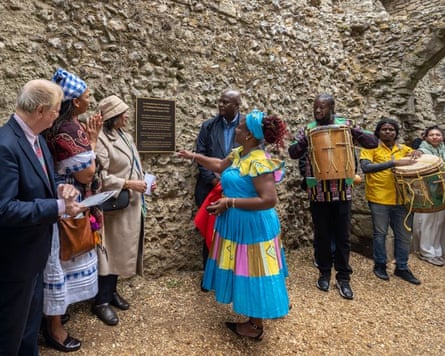
Dr Jacqueline Roberts, chief executive of SV2G, called the plaque “a sacred symbol of remembrance,” honoring ancestors who endured captivity and displacement. The phrase speaks to the depth of this loss without requiring every visitor to share the same faith or practice. Memory can be sacred because people are sacred. (University of Warwick)
The community that brought the memorial into being is now defending the history it marked. That is not a substitute for institutional responsibility. It is a demand that responsibility be met.
I keep returning to the plaque’s five days. Not because five days defines the story, but because it exposes how fragile recognition can be when it rests on a single object, and how stubborn memory becomes when people refuse to let that object carry the whole burden.
Decolonization is not only the work of removing inherited distortions. It is the work of restoring what was omitted, correcting what was misnamed, and making room for people whose lives exceed the language of empire. Haiti’s revolutionary legacy offers one enduring reminder that the Caribbean cannot be reduced to a backdrop for European history. Its people were thinkers, fighters, families, and makers of political possibility.
We do not know who took the plaque or why. We should not claim what the investigation has not established. But we do know what the marker was meant to say: these people were here; their lives belong in the record; their descendants have the right to remember them in public.
A plaque can go missing. The obligation to remember cannot.
In Alike Regardless: This Is Where It Began, I write about the difficult work of finding unity through love and self-reflection. Unity does not mean flattening history or asking anyone to forget. It begins with telling the truth about how we became divided, and choosing not to pass that division forward.
Receive the first two chapters free. Visit yvenerduroseau.com or text COLONIZATION to +1 318-667-8226.
Get the first two chapters

Listen, reflect, and join the conversation
Explore Haitian history, cultural pride, identity, mental liberation, and the beliefs that shape how we understand ourselves and the world.
Digital Media Platform & Talk Show
High-impact conversations redefining Haiti’s global narrative while connecting the Haitian diaspora with the homeland through history, cultural pride, and future innovation.

Podcast
Thought-provoking conversations examining inherited beliefs about faith, language, history, culture, education, identity, and human worth.

