
Digital Media Platform & Talk Show
1804 Renaissance
High-impact conversations redefining Haiti’s global narrative while connecting the Haitian diaspora with the homeland through history, cultural pride, and future innovation.


Category: History & Narrative Power
Overview: A bottle of Grand Constance carries more than the taste of a celebrated wine: it carries a history that, for generations, too often went unnamed. South Africa’s vineyards are beginning to acknowledge the enslaved people whose labor helped build them, but the present asks whether recognition can mean more than a plaque on a wall.
Imagine a glass of Grand Constance poured at Groot Constantia, South Africa’s oldest wine farm. The sweet wine is reputed to have been a favorite of Napoleon. Nearby, two plaques name people who were forcibly taken from Mozambique, Madagascar, India, Sri Lanka and Indonesia and made to labor on the estate. The Guardian’s report asks us to hold both images at once.
What are we tasting when we taste 340 years of history?
Not only grapes and craft. We are tasting the choices a society has made about what to remember, what to leave out, and whose labor can disappear behind a beautiful view.
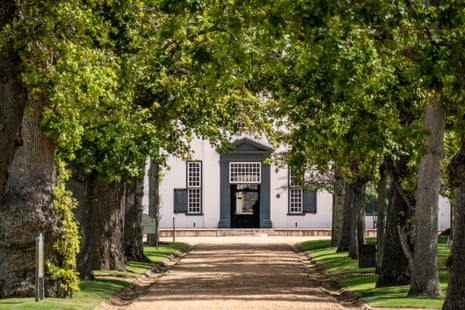
The manor house at Groot Constantia. Source: The Guardian.
A report published by The Guardian on October 26 describes descendants of enslaved people reclaiming their history across South Africa’s wine country. Slavery, the report makes clear, was integral to the wine industry. Yet only a handful of estates explicitly acknowledge that legacy. The report gives us a place to see what that acknowledgment can look like.
Groot Constantia was founded in 1685 by Governor Simon van der Stel under the Dutch East India Company. About 30 enslaved people lived on the estate at any given time from its founding until the British colonial government abolished slavery in 1834, according to The Guardian and Iziko Museums.
The estate’s museum, run by Iziko Museums, includes the history of slavery. Two plaques list names.
That is not a small act. A name insists on a person where a record might otherwise offer only a number. A name pushes against the old, normalized story that land and wealth simply appeared, detached from the people who made them possible.
Groot Constantia CEO Jean Naudé told The Guardian: “We have accepted that it’s part of our history and we are actually grateful for what they have done.” He added that “the least we can do today is to build something proper on that foundation.” The words matter. So does the question that follows them: what does “something proper” require?
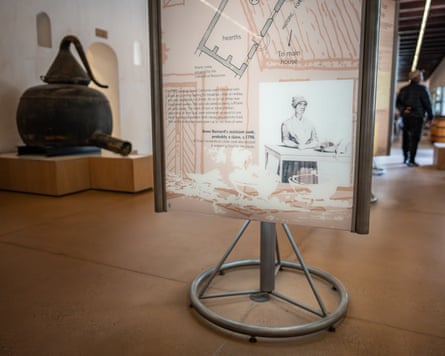
An exhibit in Groot Constantia’s on-site museum. Source: The Guardian.
The history does not begin with a vineyard. Jan van Riebeeck established a Dutch East India Company colony in what is now Cape Town in 1652. Enslaved people were brought there within a few years, according to the historical accounts cited in The Guardian.
By the 19th century, the 21 most prominent wine-industry families owned 3,557 enslaved people between them, according to Wayne Dooling, a lecturer at the School of Oriental and African Studies, as cited in the report. Historian Kate Ekama of Stellenbosch University says that by the 1820s about 80 percent of “coerced” workers were enslaved, while the remainder were dispossessed Indigenous people. The Guardian reports both estimates.
Let the numbers sit for a moment.
The wine industry was not merely near this system. It depended on it. And the industry remains a major business: South African wine sales reached R36.3 billion last year, about £1.65 billion, according to The Guardian and South Africa Wine’s 2026 industry overview.
The contrast is plain. An industry can tell a story of excellence while telling little of the people whose coerced labor helped create its wealth.
Linda Mbeki, Iziko’s curator at Groot Constantia, offers the sharpest explanation for why many historic farms still lack slavery memorials: “People don’t want to sully their legacy.” To acknowledge slavery, she says, and “to acknowledge culpability, if not directly, comes with privilege and generational wealth.” The Guardian reports her words.
Memory is not neutral. Silence can preserve an inheritance as surely as a deed or a wall. It allows descendants to encounter the beauty of an estate without encountering the people made absent from its story.
This is one way I understand decolonization of the mind: not as a slogan, but as the work of examining the stories we learned to accept as complete. The land was taken in material ways; then, in the narrative, the people who shaped it could be taken from view again. First came the forced removal from home and the violence of enslavement. Then came the danger of being left out of the record.
A plaque interrupts that second erasure. It does not undo the first.
The present refuses to stay politely in the past. Unions and workers’ rights groups connect the history of slavery through colonialism and apartheid to the circumstances of wine-farm workers today, many of whom are descended from enslaved people, The Guardian reports.
The Trust for Community Outreach and Education and the Commercial, Stevedoring, Agricultural and Allied Workers Union say at least 10 families, mostly former workers, have been evicted from Groot Constantia since July 2026. TCOE director Mercia Andrews says, “those that have given their labour and that have built the sector can be easily dispensed of.” The Guardian attributes the figure to the organizations.
Naudé says evictions took place only with court orders, and describes the estate as a responsible employer, according to The Guardian’s account. Rico Basson, CEO of South Africa Wine, acknowledges that slavery left “deep social and economic inequalities”; he says recognizing history and improving workers’ circumstances are both important, the report notes.
These positions deserve to be heard fairly. And the larger question remains: can a society honor labor in its museum while leaving the workers and their families insecure in the present?
Memory without material change risks becoming decoration.
Solms-Delta, a Franschhoek farm founded in 1690, tried to make memory material. Mark Solms bought the estate in 2001 and helped workers establish a trust to buy a neighboring farm in 2005. From 2004 to 2016, historian Tracey Randle conducted excavations, created a history museum and helped workers revive musical traditions, according to The Guardian.
Nico Jansen, a third-generation resident of Khoikhoi heritage, became the estate manager. “We built this land with our blood and tears and sweat,” he says. “And now it’s being taken away.” The Guardian.
Solms-Delta is not currently operating. The Guardian reports that the government took over the workers’ shares in 2016 without providing the promised financial contribution, while a 2018 government statement describes a 45 percent worker stake and government support, and also records that the estate continued to operate at a loss. An American technology executive has pledged to buy back the government’s shares for the workers, with negotiations ongoing, according to The Guardian.
The story is not a simple model of success. That is precisely why it matters. A museum, a trust, land, and music can help return agency and memory. They do not make restitution easy, automatic, or complete.
In Alike Regardless: This Is Where It Began, I write about the possibility of seeing our shared humanity without denying the differences history has made. That work begins with honesty. Unity cannot ask descendants to surrender memory in exchange for comfort.
A name on a plaque is not the destination. It is the beginning of a debt spoken aloud. The people who built the land are asking to be seen twice: once in the record, and once in the present. To reclaim the mind is to refuse the old story of who mattered. To rewrite the future, we must tell the truth about what built it.
Receive the first two chapters free. Visit yvenerduroseau.com or text COLONIZATION to +1 318-667-8226.
Get the first two chapters

Listen, reflect, and join the conversation
Explore Haitian history, cultural pride, identity, mental liberation, and the beliefs that shape how we understand ourselves and the world.
Digital Media Platform & Talk Show
High-impact conversations redefining Haiti’s global narrative while connecting the Haitian diaspora with the homeland through history, cultural pride, and future innovation.

Podcast
Thought-provoking conversations examining inherited beliefs about faith, language, history, culture, education, identity, and human worth.

