
Digital Media Platform & Talk Show
1804 Renaissance
High-impact conversations redefining Haiti’s global narrative while connecting the Haitian diaspora with the homeland through history, cultural pride, and future innovation.

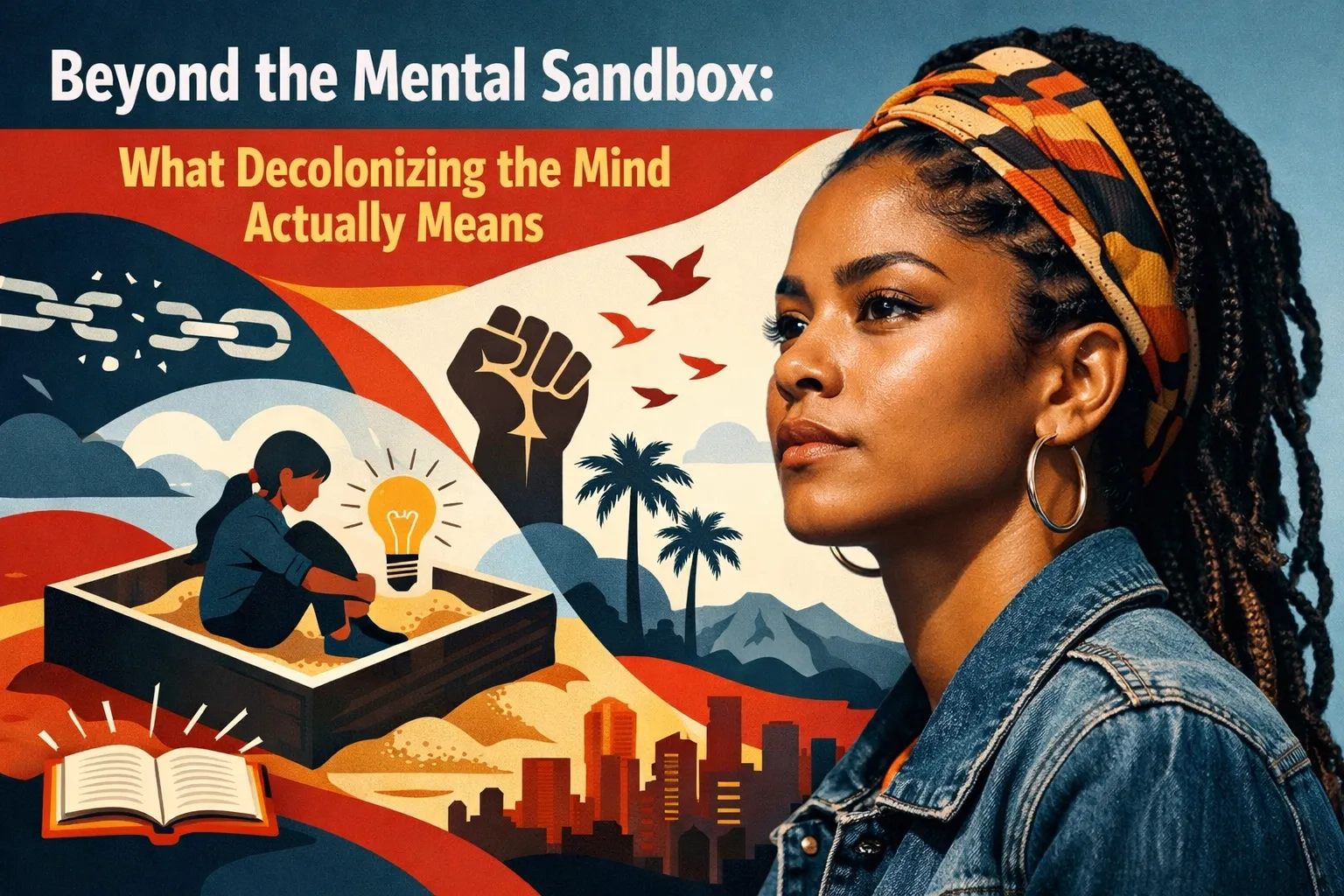
Who owns the architecture of your thoughts? If you were to strip away every value taught in a classroom, every hierarchy sanctified by a pulpit, and every standard of beauty broadcast on a screen, what would remain of your identity? Most of us live within a mental sandbox. The walls are high. The sand is imported. The borders of what we consider “rational,” “civilized,” or “true” were mapped out long before we were born by architects who did not have our liberation in mind. We speak of freedom, yet we think in the language of our historical captors. We speak of progress, yet we measure it by the metrics of the very systems that once commodified our ancestors. This is the quiet tragedy of the modern era. The empire did not retreat; it simply moved indoors. It migrated from the plantations and the colonies into the folds of the human brain. To understand decolonization meaning in the twenty-first century, we must stop looking at maps and start looking at our own reflections. We must recognize that the most fortified fortress is not built of stone, but of internalized colonialism.

History is often taught as a series of departures. We learn about the lowering of flags. We learn about independence ceremonies. We learn about the physical exit of colonial administrators. But the psyche does not follow a legislative calendar. The colonial education system was never designed to produce thinkers; it was designed to produce subjects. It was a factory of “epistemic coloniality,” a term scholars use to describe the systematic erasure of indigenous knowledge in favor of a “universal” Western standard. When we were taught that history began with the “discovery” of the Americas, a seed was planted. When we were taught that “classical” music only refers to Europe, the seed grew. When we were taught that our native languages were “dialects” and our religions were “superstitions,” the tree of colonial mentality bore fruit. The result is a fractured consciousness. We learn to view our own heritage through the eyes of an outsider. We learn to devalue the wisdom of our elders while venerating the theories of men who lived thousands of miles away and viewed us as sub-human. In my book, Decolonization of the Mind, I explore how this educational grooming creates a vacuum. We become experts in a world that does not belong to us, while remaining strangers to ourselves.
To see the truth, we must look at Haiti. 1804 was not merely a military victory. It was a psychological explosion. The Haitian Revolution remains the most significant challenge to the colonial narrative in human history. It was the moment the “property” stood up and declared itself the “proprietor.” Yet, how is Haiti discussed today? It is framed through the lens of poverty, instability, and “failed state” narratives. This is intentional. The global power structure cannot forgive Haiti for proving that the colonial myth was a lie. By pathologizing Haiti, the modern world attempts to keep the colonial mentality intact. It warns us that to truly break free: to truly decolonize: is to invite ruin. But the ruin is already here. It is the ruin of the soul. It is the neurosis of the person who hates their own hair, their own skin, and their own history because they have been conditioned to worship an aesthetic that excludes them. The courage to remember is the first step toward freedom. The courage to reject the “sandbox” is the second.

Colonialism is a visceral experience. It is not just an abstract theory; it is a physical weight. It is the tension in the shoulders when you enter a space where you feel you do not belong. It is the “code-switching” that exhausts the mind by midday. We have been conditioned to process pain, but not to heal it. We have been conditioned to endure trauma, but not to transcend it. This internalization creates a cycle of self-sabotage. When we carry the “colonizer” inside our heads, we become our own most effective jailers. We police our dreams. We stifle our creativity. We mock our own people for “acting out” or for failing to meet the standards of a “civilization” that was built on our backs. This is what it means to decolonize your mind. It is a process of neuroplasticity. It is the radical act of re-wiring the brain to recognize its own worth. It is about unlearning the belief that there is a hierarchy of human value based on race, geography, or capital. In Alike Regardless: This Is Where It Began, I argue for a return to our shared humanity. But we cannot reach that shared humanity until we dismantle the false divisions created by colonial systems. Unity is impossible without the truth. And the truth is that we have been lied to about who we are.
We must also confront the role of religion in this mental occupation. For centuries, faith was used as a tool of pacification. A version of God was exported that looked like the conqueror and demanded the submission of the conquered. When the Divine is framed as something external to you: something that belongs to another culture and another race: your spiritual life becomes an act of imitation. To decolonize the mind is to reclaim the sacred. It is to realize that the spirit does not carry a passport. It is to understand that healing: true, deep, ancestral healing: cannot happen within the same framework that caused the wound. We often see people substituting faith for healing, as I discussed in a recent reflection on faith and healing. But true faith requires the liberation of the mind. You cannot pray for freedom while holding the keys to your own handcuffs.

Language is the carrier of culture. When a language dies, a world dies with it. When we are forced to express our deepest emotions in a tongue that was designed to categorize and control us, something is lost in translation. The “mental sandbox” is built with the words we use. If we only have words for “competition,” “debt,” and “status,” we will never be able to build a world based on “community,” “gift,” and “being.” We must become linguistic rebels. We must find the words that were stolen from us. We must speak our truth even if our voices shake. We must realize that the “Standard English” or “Proper French” we strive for is often just a marker of how well we have assimilated into our own erasure.
Decolonizing the mind is not a destination. It is a daily practice. It is the practice of questioning your reactions. It is the practice of auditing your influences. It is the practice of radical self-love in a world that profits from your self-hatred. We are living in a moment of great transition. The old narratives are crumbling, but the new ones have not yet taken hold. This is the “interregnum”: the space between worlds. In this space, we have a choice. We can stay in the sandbox, safe but small. Or we can climb over the walls and see the horizon for what it is: an infinite expanse of possibility. The path to human unity begins with the individual’s refusal to be a colony. It begins with the realization that your mind is not a territory to be occupied, but a landscape to be cultivated. The work is difficult. The work is uncomfortable. The work is necessary. Because a mind that is truly free cannot be governed by fear. A mind that is truly free cannot be bought. A mind that is truly free is the only thing that can actually change the world. Are you ready to step out of the sandbox?

The architecture is waiting to be rebuilt. This time, by you. For more insights on the journey toward mental liberation and our shared human story, explore the latest articles or join the conversation on the homepage.

Upcoming book by Yvener Duroseau
A thought-provoking examination of the inherited beliefs, systems, histories, and invisible forces that shape how we understand faith, language, identity, culture, power, and human worth.
Release date: May 18, 2027
Begin the reflection with a free preview of the book.

Listen, reflect, and join the conversation
Explore Haitian history, cultural pride, identity, mental liberation, and the beliefs that shape how we understand ourselves and the world.
Digital Media Platform & Talk Show
High-impact conversations redefining Haiti’s global narrative while connecting the Haitian diaspora with the homeland through history, cultural pride, and future innovation.

Podcast
Thought-provoking conversations examining inherited beliefs about faith, language, history, culture, education, identity, and human worth.
