
Digital Media Platform & Talk Show
1804 Renaissance
High-impact conversations redefining Haiti’s global narrative while connecting the Haitian diaspora with the homeland through history, cultural pride, and future innovation.

Category: Decolonization of the Mind
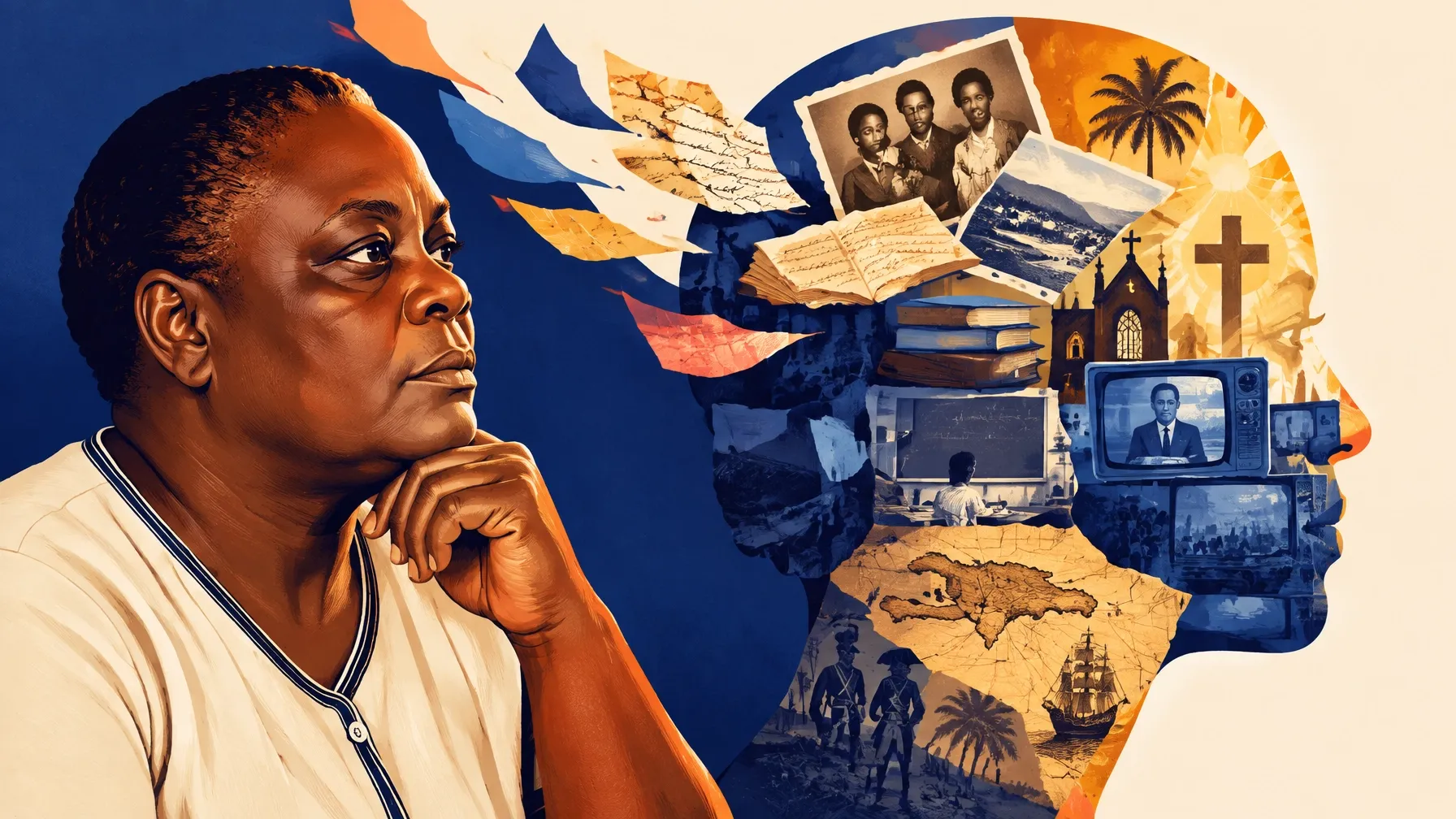
Episode 2 of Who Taught You That? : A 1804 Renaissance Podcast asks whether our thoughts are truly our own. This article examines how family, school, religion, media, politics, economics, and colonial history shape the inner voice we mistake for personal truth. It also offers a practical five-question Thought Audit for separating inherited wisdom from inherited limitation.
Watch the complete Episode 2 video: Who Taught You That? : Episode 2
Have you ever believed something about yourself for years, only to discover that the belief began in someone else’s mouth?
Perhaps you thought you were not intelligent enough.
Perhaps you thought your language sounded unprofessional.
Perhaps you thought your culture was something to hide.
The thought felt personal.
But where did it begin?
Who placed it there?
And how long have you been carrying it?
Episode 2 of Who Taught You That? : A 1804 Renaissance Podcast begins with that difficult question: Are all of our thoughts really our own?
The question is not an accusation.
It is an invitation to become conscious.
Long before we can analyze a message, we absorb it.
We listen.
We watch.
We repeat.
We adapt.
As children, we learn what is considered good and bad. We learn who receives respect and who is ignored. We learn which people are described as intelligent, dangerous, beautiful, successful, or disposable.
Most of these lessons are not presented as opinions.
They are presented as facts.
“People like us do not become doctors.”
“Your language will not take you anywhere.”
“Do not challenge authority.”
“Stay in your place.”
“Be grateful for whatever you receive.”
Sometimes these messages are spoken directly.
Sometimes they are communicated through silence.
A child notices when one accent is called elegant and another is mocked. A child notices when one name is pronounced carefully and another becomes a joke. A child notices when history begins with Europe and treats Africa, Haiti, Indigenous nations, and the Caribbean as marginal chapters.
A child notices when the heroes in the books never look like them.
What surrounds us repeatedly begins to feel normal.
That is how conditioning works.

Not everything we inherit is harmful.
Our families and communities give us love, resilience, wisdom, humor, music, recipes, stories, and ways of surviving circumstances that should never have been imposed upon us.
We inherit language.
We inherit rhythm.
We inherit memory.
We inherit the ability to endure.
These are not chains.
They are resources.
But alongside those gifts, we may also inherit fear, shame, silence, and ideas designed to keep us within a particular place.
A parent may tell a child not to speak their ancestral language in public because that parent was once punished or humiliated for using it. The instruction may have begun as protection.
The child may still hear shame.
That distinction matters.
A family can love us and still pass down survival strategies that no longer serve us. A religious tradition can offer meaning and still be used to discourage questions. A school can teach literacy and still decide whose history counts as knowledge.
The issue is not influence.
Human beings cannot develop in isolation.
The issue is whether we are allowed to examine what we have received.
Healthy learning gives us tools.
Conditioning gives us limits.
Healthy learning says, “Here is what I believe. Explore it.”
Conditioning says, “This is the only truth. Do not question it.”
Healthy learning expands imagination.
Conditioning narrows possibility.
Healthy learning helps us become more fully ourselves.
Conditioning pressures us to become acceptable to someone else.
That is the dividing line.
Power does not always need to remain visible.
At first, someone else says, “You are not good at this.”
Eventually, you say, “I am not good at this.”
At first, someone else says, “Your culture is backward.”
Eventually, you distance yourself from it.
At first, someone else says, “Your language is not professional.”
Eventually, you apologize for the way you speak.
At first, someone else defines beauty through their own image.
Eventually, you look into the mirror through their standards.
The message has moved inside.
You monitor yourself.
You correct yourself.
You reject yourself before anyone else has the opportunity.
This is one of the most effective forms of control because it can feel like personal choice.
Colonial systems did not only control land, labor, and political institutions. They also claimed the authority to define what was civilized, educated, moral, beautiful, religious, and human.
Those definitions could enter classrooms, churches, workplaces, homes, and intimate beliefs about the self.
Haiti’s revolutionary history offers a profound counterpoint to that process. A system that declared Black people property was challenged by people who refused to accept the definition imposed upon them. Their struggle exposed a truth that remains relevant: domination often begins by naming another person as less than fully human.
Mental liberation begins when we question the names we have internalized.
This is not a rejection of faith, family, or culture.
It is a refusal to let inherited authority become unquestionable authority.
For a related exploration of how belief and spiritual power intersect, read “Faith or Control? Reexamining Religion Through a Decolonial Lens”.

Choose one belief you carry about yourself.
Write it down exactly as it appears.
“I am not intelligent.”
“My culture is holding me back.”
“I have to be perfect to deserve respect.”
“I cannot succeed without becoming someone else.”
“I should not question religious authority.”
Then ask five questions.
Was it a parent, teacher, religious leader, friend, television show, social media platform, workplace, or political system?
Try to locate the earliest memory attached to the belief.
Does the belief make you easier to control?
Does it keep you silent?
Does it prevent you from pursuing an opportunity?
Does it make you dependent upon someone else’s approval?
Some beliefs do not merely describe the world.
They organize power within it.
Be honest.
Do not simply repeat the belief as proof of itself.
Look for actual evidence.
What experiences appear to support the thought?
What patterns have you observed?
What facts are present?
Think about your achievements.
Think about the people who have affirmed your ability.
Think about the moments when the belief was proven incomplete or false.
A belief can feel familiar and still be inaccurate.
A belief can be traditional and still be harmful.
A belief can be popular and still be untrue.
This is the central question.
Not, “Does this belief make me comfortable?”
Not, “Has my family always believed this?”
Not, “Will everyone approve of my decision?”
Is it helping you become free?
Freedom does not require empty positivity.
It requires conscious examination.
Some people fear that questioning inherited beliefs means abandoning their roots.
They worry that questioning religion means losing faith.
They worry that questioning culture means losing identity.
They worry that questioning family beliefs means betraying the people who came before them.
But questioning does not automatically mean abandoning.
Imagine receiving a box from your family.
Inside are photographs, recipes, music, stories, memories, and wisdom.
There are also broken objects, old fears, and limitations that no longer belong in your life.
Honoring your family does not mean keeping every object in the box forever.
You can preserve the recipe.
You can keep the song.
You can remember the story.
You can release the fear.
You can ask about the object no one can explain.
You do not have to keep something simply because someone says it has always been in the family.
This is cultural discernment.
It is not cultural betrayal.
The work of decolonization asks us to separate what is life-giving from what has been mixed with hierarchy, shame, fear, or control. It asks us to reclaim language without romanticizing every inherited message. It asks us to engage faith without surrendering our capacity for thought. It asks us to remember history without allowing inherited pain to become our only identity.
For more on language and the power of inherited definitions, read “The Power of Language: How Words Shape Our Colonial Mentality”.

Are all your thoughts really your own?
Some are.
Some are inherited.
Some are reactions to pain.
Some were shaped by love.
Some were created by fear.
Some were imposed by systems that benefited from your confusion.
The purpose is not to feel ashamed.
The purpose is to become aware.
Yvener Duroseau’s forthcoming book, The Colonization of the Mind: Breaking the Invisible Chains of Thought, scheduled for release on May 18, 2027, will continue examining how inherited ideas shape identity, faith, language, culture, and worth.
But the practice begins now.
Choose one belief.
Ask where it came from.
Ask who benefits from it.
Ask what evidence supports it.
Ask what evidence challenges it.
Ask whether it is helping you become free.
The voice in your head may be familiar.
That does not mean it originated with you.
And freedom begins when you recognize the difference.
“Receive the first two chapters free. Visit yvenerduroseau.com or text COLONIZATION to +1 318-667-8226.”

Upcoming book by Yvener Duroseau
A thought-provoking examination of the inherited beliefs, systems, histories, and invisible forces that shape how we understand faith, language, identity, culture, power, and human worth.
Release date: May 18, 2027
Begin the reflection with a free preview of the book.


Listen, reflect, and join the conversation
Explore Haitian history, cultural pride, identity, mental liberation, and the beliefs that shape how we understand ourselves and the world.
Digital Media Platform & Talk Show
High-impact conversations redefining Haiti’s global narrative while connecting the Haitian diaspora with the homeland through history, cultural pride, and future innovation.

Podcast
Thought-provoking conversations examining inherited beliefs about faith, language, history, culture, education, identity, and human worth.
