Category: Decolonization of the Mind
Overview:
This essay explores the invisible psychological structures that govern our sense of worth, identity, and social interaction. By contrasting the internalized “germs of rot” from colonial history with the active, healing reclamation found in decolonization psychology, we examine how to break free from mental chains and embrace a future of genuine human unity.
Look in the mirror.
Who is looking back?
Is it the architect of your own soul, or the ghost of a system designed to make you small?
We often speak of colonization as a matter of maps and musket fire.
We speak of it as a finished chapter in a dusty textbook.
But the most enduring borders are not drawn on land.
They are etched into the psyche.
They are the silent assumptions about which language sounds “intelligent.”
They are the quiet preferences for certain shades of skin or textures of hair.
They are the “internalized germs of rot” that persist long after the flags have changed.
The Shadow of the Past
History tells us that physical liberation is only the first step.
Consider Haiti in 1804.
The chains were broken.
The world’s first Black republic was born from the fires of revolution.
It was a victory that shook the foundations of global power.
Yet, as the smoke cleared, a deeper battle began.
The battle for the mind.
Colonialism is not satisfied with merely holding a people in its grip.
As Frantz Fanon observed in The Wretched of the Earth: “It turns to the past of the oppressed people, and distorts, disfigures, and destroys it.”

This is the essence of the colonial mentality.
It is a psychological architecture built on the premise of lack.
Not to possess, but to be possessed.
Not to create, but to imitate.
Not to lead, but to follow.
It creates a “neurotic orientation” where the colonized person finds themselves constantly seeking validation from the very systems that sought to erase them.
The Cultural Bomb
In his seminal work Decolonising the Mind, Ngũgĩ wa Thiong’o speaks of the “cultural bomb.”
He describes it as a weapon daily unleashed to annihilate a people’s belief in their names, their languages, and their environment.
The effect is visceral.
It makes people see their own history as a wasteland of non-achievement.
It makes them want to distance themselves from themselves.
The courage to speak our native tongue is stifled by the desire for “status.”
The courage to worship through our ancestral traditions is replaced by a fear of being “primitive.”
The courage to define our own worth is traded for the cold comfort of colonial approval.
We must recognize this for what it is: a fractured state of being.
We have been conditioned to see our own reflection through a distorted lens.
We have been taught to sanctify the symbols of our own subjugation.
This is not a failure of character.
It is a success of the system.
The Psychology of Decolonization
Decolonization psychology is the antidote.
It is the clinical detection and removal of those “germs of rot.”
It is not a passive process of waiting for change.
It is an active, often painful, “calling in question” of everything we have been taught to value.
Fanon declared that “decolonization is the veritable creation of new men.”
It is a psychological rebirth.
It requires the bravery to look at the structures of our society: our education, our faith, our media: and ask: “Whose interest does this serve?”
Does it serve the expansion of the human spirit, or the preservation of a colonial hierarchy?

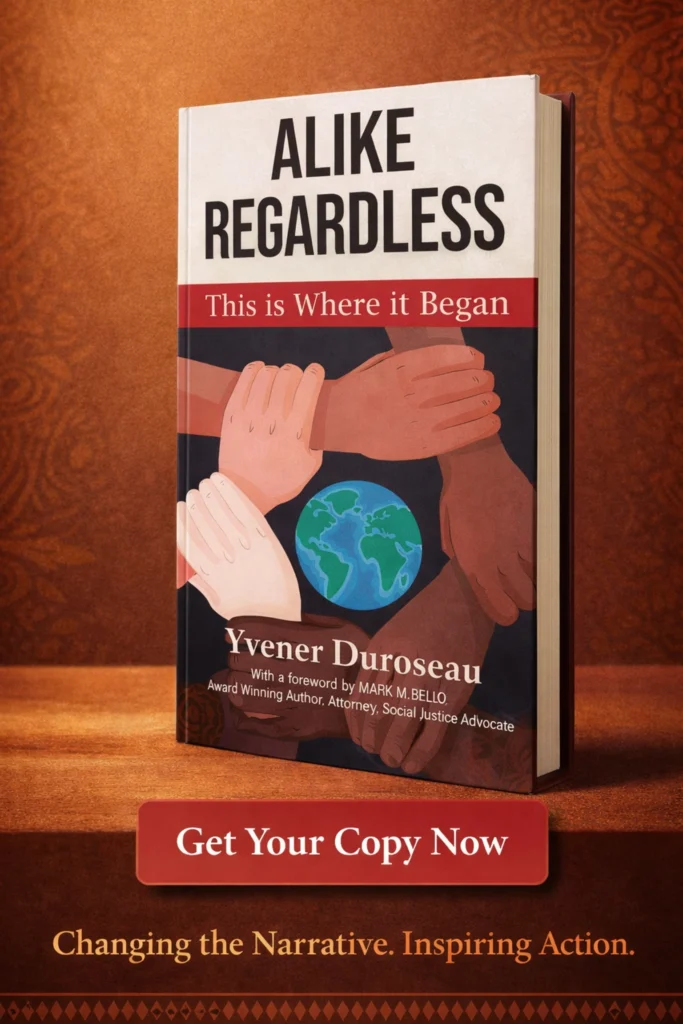
In my book, Alike Regardless: This Is Where It Began, I explore how this internal work is the necessary precursor to true human unity.
We cannot find common ground if the ground we stand on is still poisoned by the myths of superiority and inferiority.
We cannot love our neighbor if we have been trained to hate the very things that make us unique.
The journey toward decolonization is a journey toward the “I” and the “We.”
It is about reclaiming the power to define our own universe.
From Fracture to Wholeness
We must ground this theory in the body.
The tension in the shoulders when you speak your truth.
The hesitation in the throat when you use your mother tongue.
The shame that bubbles up when you don’t fit the “standard.”
These are the physical markers of a colonial mentality.
To decolonize is to breathe through that tension.
To decolonize is to speak until the hesitation vanishes.
To decolonize is to replace that shame with a radical self-acceptance.
It is a journey of memory.
We must remember what was forgotten.
We must honor what was dishonored.
We must build what was destroyed.
This is the theme of my forthcoming work, Decolonization of the Mind.
It is the necessary labor of our generation.
Not just to protest the external structures, but to liberate the internal landscape.
A New Narrative
We are at a crossroads.
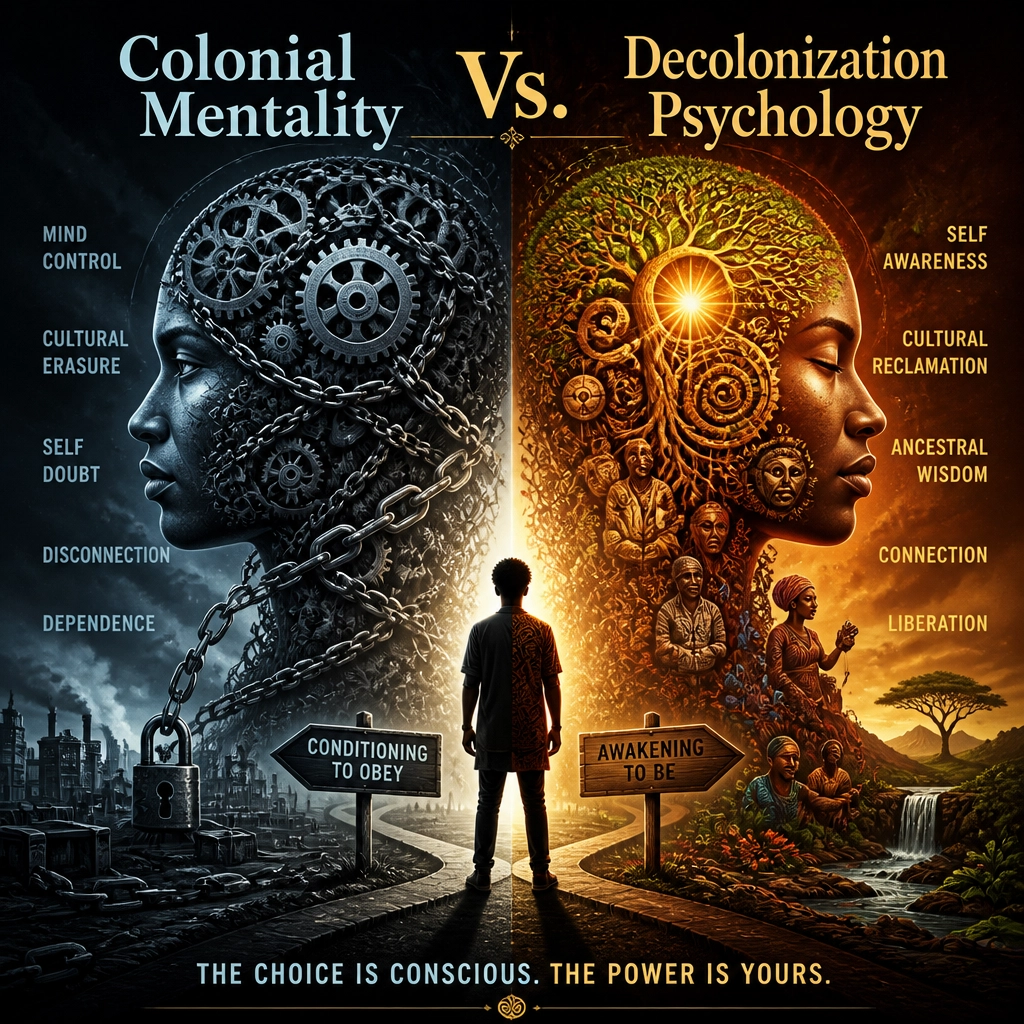
The colonial mentality offers us a world of division, where worth is a finite resource and someone must always be “lesser.”
Decolonization psychology offers us a world of unity, where our differences are not deficits but parts of a brilliant, collective whole.
The choice is ours.
Every day, we decide which psychology will run our lives.
Will we continue to endure the pain of a fractured identity?
Or will we have the courage to heal?
The courage to remember.
The courage to reclaim.
The courage to be whole.
It begins with a single question.
Whose voice is speaking through you?
If it is not your own, it is time to find it.
Purchase ‘Alike Regardless: This Is Where It Began’ on Amazon