
3. You View Your Mother Tongue as a Barrier
Language is the architecture of the mind.
When we are told that our native dialects or ancestral languages are "broken" versions of colonial tongues, we begin to believe our thoughts are broken, too.
In Haiti, Kreyòl was the language of the revolution.
It was the language of the oath.
It was the language that built a nation.
To view your language as a hurdle to overcome is to view your history as a shame to hide.
The Fix: Recognize language as a technology of resistance.
Your language is a bridge to an uncolonized part of your soul.
Speak it with the dignity it deserves.
4. You Pathologize Your Resistance
Standard psychology often looks at the effects of oppression and calls them "disorders."
Low self-esteem.
Anxiety.
Cognitive distortions.
But what if your "anxiety" is actually a rational response to a system that was built to work against you?
What if your "defiance" is not a personality flaw, but a survival mechanism?
Internalized colonialism makes us feel "broken" for having human reactions to inhumane conditions.
The Fix: Shift the focus from "fixing" the individual to "analyzing" the system.
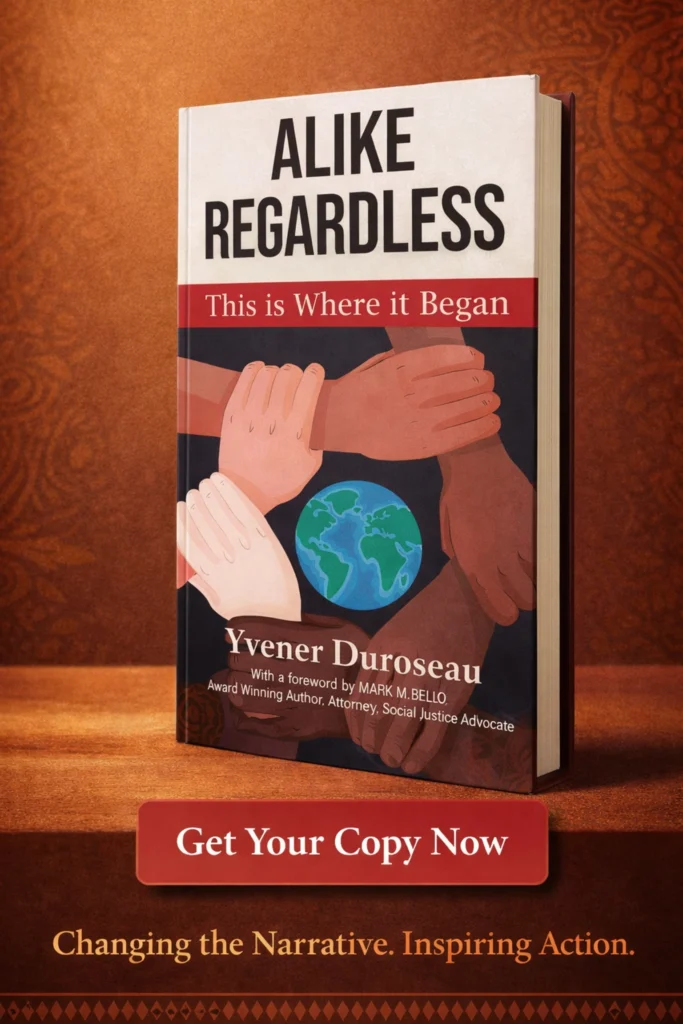
In Alike Regardless: This Is Where It Began, I explore how we must find unity through a deep understanding of where our divisions began.
We cannot heal a mind that is still trying to please its captor.
Healing begins when you stop calling your survival "sickness."
5. You Seek Validation from Colonial Institutions
The courage to create.
The courage to speak.
The courage to lead.
Too often, we wait for a degree, a title, or a "verified" badge from an institution that was never meant for us.
We seek the "sanctify" of the system to prove our worth.
But the system cannot validate the very thing it was designed to suppress.
If you wait for permission to be powerful, you have already lost.
The Fix: Build your own pedestals.
Look to the Maroon communities.
Look to the underground networks of the enslaved.
They did not wait for a permit to be free.
They took it.
6. You Neglect the Haitian Revolutionary Blueprint
We are taught about the French Revolution.
We are taught about the American Revolution.
We are rarely taught about the 1804 Haitian Revolution in a way that centers its psychological genius.
This is a mistake.
The Haitian Revolution is the ultimate case study in decolonization psychology.
It proves that the first battle is won in the mind: at the Bois Caïman, in the forest, away from the gaze of the master.
The Fix: Study the facts of the Haitian Revolution as a manual for mental liberation.
Learn how they turned European "universal rights" against Europe itself.
Learn how they refused the colonial racial hierarchy by declaring all citizens "Black" as a political identity of freedom.
The blueprint for your liberation already exists.
7. You Forget That the Mind and Body Are One
Colonialism is not just an idea.
It is a physical experience.
It is the tension in your shoulders when you enter certain spaces.
It is the way you hold your breath.
Decolonization psychology teaches us that we store the memory of oppression in our nervous systems.
If you only decolonize your reading list, but not your breathing, you are only half-free.
The Fix: Incorporate somatic practices into your liberation work.
Move.
Breathe.
Dance.
Reclaim the space your body occupies.
Freedom is a visceral reality, not just an intellectual concept.
The Quiet Urgency of Now
The process of decolonization is not a destination.
It is a discipline.
It requires the constant unlearning of what was once "normalized."
We must have the courage to question the very foundations of our beliefs.
The courage to look at our faith, our language, and our worth with fresh eyes.
The courage to be whole in a world that profits from our fragmentation.
In my forthcoming work, Decolonization of the Mind, I delve deeper into these psychological structures and how we can systematically dismantle them.
Until then, we must look to the lessons of the past.
We must look to the strength of those who came before us.
We must realize that the mirror was never broken: only our perception of ourselves within it.
If you are ready to begin this journey of self-reflection and unity, I encourage you to read Alike Regardless: This Is Where It Began.
It is a step toward understanding that we are more than the labels imposed upon us.
We are the authors of our own narrative.
We are the architects of our own liberation.
Reclaim your mind.
The revolution depends on it.

Yvener Duroseau
Yvener Duroseau is a cultural commentator, speaker, and the author of Decolonization of the Mind and Alike Regardless. He’s on a mission to help people break free from inherited colonial narratives and reclaim their mental agency. Through his writing and the 1804 Renaissance podcast, Yvener centers Haiti’s revolutionary legacy as a lens for global liberation and self-reflection.
Popular Posts


Close