
Digital Media Platform & Talk Show
1804 Renaissance
High-impact conversations redefining Haiti’s global narrative while connecting the Haitian diaspora with the homeland through history, cultural pride, and future innovation.

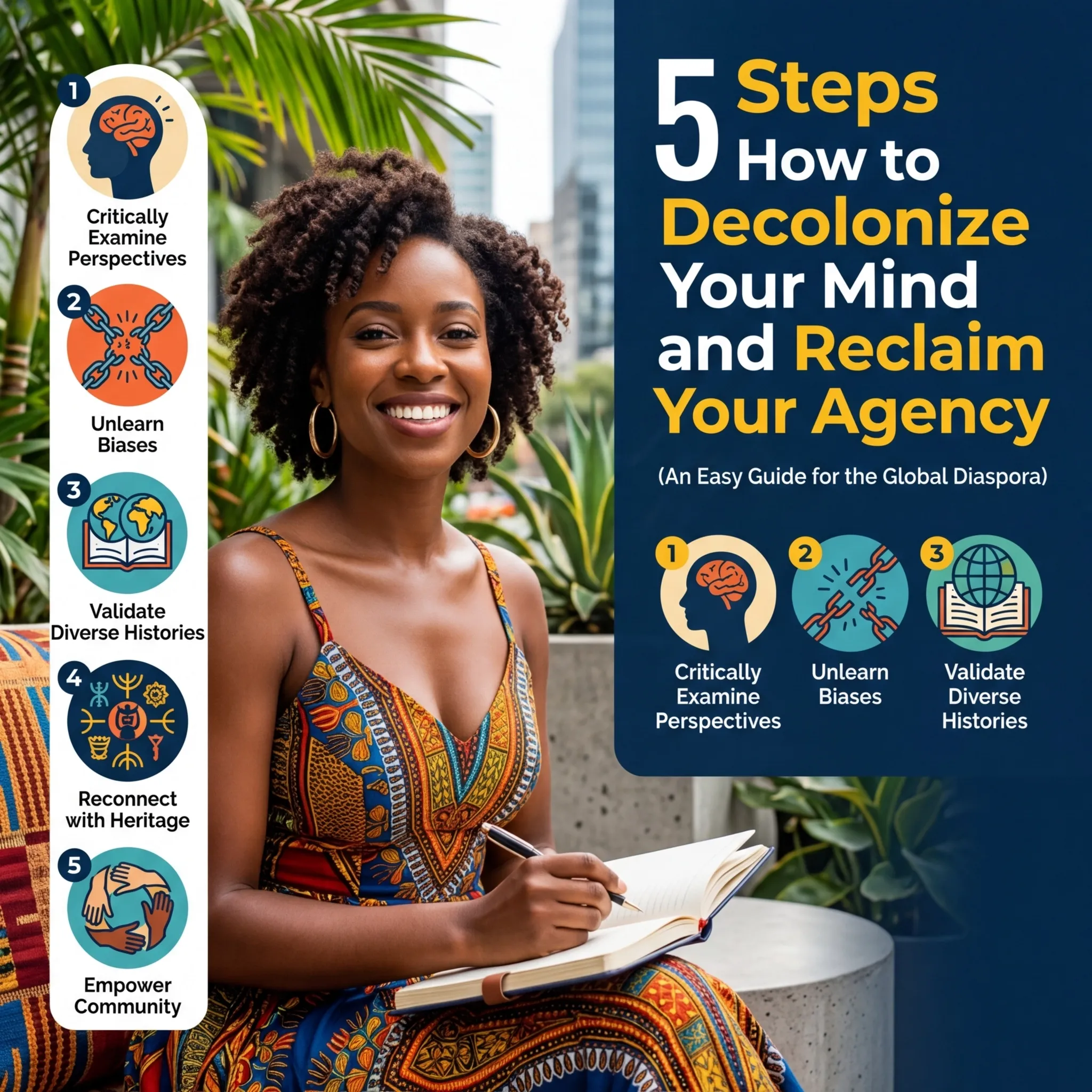
Category: Decolonization of the Mind
Who owns the voice inside your head when you are silent?
We often assume our thoughts are our own, birthed from our unique experiences and filtered through our personal values.
But for the Global Diaspora, the mind is rarely a private sanctuary.
It is a contested territory.
It is a landscape littered with the ruins of colonial architecture, designed to house thoughts of inferiority, scarcity, and division.
To decolonize the mind is not a simple act of political protest.
It is a visceral, psychological excavation.
It is the process of shedding external labels and regaining belief in your indigenous brilliance.
It is a journey back to a self that existed before the world told you who you were supposed to be.
The first step toward liberation is recognizing that you are living inside a structure you did not build.
Our mentalities, our knowledge systems, and our values are often rooted in the worldview of the colonizer.
This is not a failure of character; it is the intended result of a system designed to sustain itself through our compliance.
In the history of the West, the year 1804 stands as a singular, terrifying anomaly for the status quo.
The Haitian Revolution was not merely a physical uprising; it was a cognitive explosion.
It was the moment the enslaved decided that the "universal" rights of man actually applied to them.

When we look at Haitian Revolution facts, we see the blueprint for mental liberation.
The revolution began in the mind before the first torch was lit.
It began with the rejection of the colonial narrative that Black bodies were meant for labor and Black minds were meant for silence.
To decolonize, you must first ask: Who told me this is how the world works?
Who told me that my history began with chains and ended with "integration"?
The courage to question the architect.
The courage to inspect the foundation.
The courage to admit that the walls are closing in.
Language is the primary tool of colonization.
It is the medium through which we are taught to categorize ourselves and others.
For many in the diaspora, the "colonizer’s tongue" is the only one we have left to describe our pain.
We use a language that was never meant to express our divinity, only our utility.
In my reflections on the colonizer's tongue, I explore how we internalize the vocabulary of our own oppression.
We describe our hair as "difficult."
We describe our accents as "broken."
We describe our ancestral spiritualities as "superstition."
As Frantz Fanon wrote in Black Skin, White Masks: "To speak a language is to take on a world, a culture."
When we speak the language of the colonizer without critique, we inadvertently adopt his hierarchy.

To reclaim your agency, you must practice the art of naming your own reality.
Pause to feel and know your true responses rather than automatically conforming to external expectations.
The tongue must be cleansed.
The tongue must be retrained.
The tongue must be used to speak truth to power, starting with the power that resides in your own subconscious.
We are conditioned to see differences where there is only shared humanity.
We are taught to fear those who look like us but speak differently, or those who worship differently but suffer the same.
In my book, Alike Regardless: This Is Where It Began, I explore the ways in which we have been taught to emphasize our fractures rather than our fundamental unity.
The colonial project succeeds when it keeps the diaspora divided by colorism, classism, and national origin.
It sanctifies the border and demonizes the neighbor.
To decolonize the mind is to look into the mirror and see not a fragmented survivor, but a whole being.
It is to recognize that our struggles are interconnected across the Atlantic, across the Caribbean, and across the artificial lines drawn on a map in Berlin in 1884.
We must stop processing our pain through the lens of individual failure.
We must start seeing it as a systemic imposition.
Not to process pain, but to endure it.
Not to heal the wound, but to hide it.
This is the colonial mandate. We must reject it.
We have been consumers of a history written by those who sought to erase us.
Decolonization requires "personal reflection, doing one's own research, and, above all, trusting the people who come to us for help."
It is about unmooring oneself from an infatuation with European modernity.
It is about recognizing that "civilization" did not arrive on our shores in the hull of a ship.
It was already there, in our agricultural systems, our communal governance, and our sophisticated cosmologies.

My upcoming conceptual framework, Decolonization of the Mind, delves deeper into this intellectual reclamation.
It suggests that we must become the authors of our own myths.
If we do not write our own stories, we will forever be characters in someone else's nightmare.
The courage to read beyond the syllabus.
The courage to cite our ancestors.
The courage to be the authority on our own existence.
Decolonization is not a destination; it is a practice.
It is the daily choice to prioritize your internal landscape over the external noise of a society that profits from your insecurity.
It involves reconnecting with traditions that were dismissed as "primitive."
It involves practicing self-compassion while navigating intergenerational trauma.
We carry the weight of ancestors who were forced to forget.
Our task is to remember.
To remember the rhythm of the drum.
To remember the healing power of the herb.
To remember the strength of the collective.

Reclaiming agency means moving from a state of reaction to a state of creation.
We are no longer just reacting to what was done to us.
We are creating what will be for those who come after us.
The path of decolonization is lonely, but it is the only path that leads home.
It is a quiet urgency that demands we wake up before we run out of time.
We have been taught to worship the map, even when the map leads us over a cliff.
It is time to throw away the map and trust the compass of the soul.
For the Global Diaspora, agency is not something that is given by a government or a system.
Agency is something you reclaim from the wreckage of the past.
It is the recognition that you are, and have always been, Alike Regardless of the labels imposed upon you.
The chains have been broken for centuries.
It is time the mind caught up to the body.

To learn more about these themes and join the conversation on mental liberation, visit our blog home or explore our essays on history and power.
The work of decolonizing the mind is the most important work of our lives.
It is the work of becoming human again.
The courage to be.
The courage to belong to oneself.
The courage to finally, truly, be free.
Find more insights in Alike Regardless: This Is Where It Began by Yvener Duroseau.

Upcoming book by Yvener Duroseau
A thought-provoking examination of the inherited beliefs, systems, histories, and invisible forces that shape how we understand faith, language, identity, culture, power, and human worth.
Release date: May 18, 2027
Begin the reflection with a free preview of the book.


Listen, reflect, and join the conversation
Explore Haitian history, cultural pride, identity, mental liberation, and the beliefs that shape how we understand ourselves and the world.
Digital Media Platform & Talk Show
High-impact conversations redefining Haiti’s global narrative while connecting the Haitian diaspora with the homeland through history, cultural pride, and future innovation.

Podcast
Thought-provoking conversations examining inherited beliefs about faith, language, history, culture, education, identity, and human worth.
