Who am I when the lights of the empire go out?
It is a question that haunts the edges of our modern existence.
We walk through cities built by those who didn't want us to exist.
We speak in tongues that were forced upon the parched lips of our ancestors.
We carry the weight of names that were assigned, not chosen.
This is the starting point for understanding the true decolonization meaning.
It is a process that is often mistaken for a simple date in a history book.
We celebrate the lowering of one flag and the raising of another.
But the borders on a map are the easiest things to change.
The borders in the skull are far more resilient.
The Psychological Landscape of the Colonized
Decolonization is not merely a political act.
It is a psychological reclamation.
In its formal sense, it refers to a nation gaining independence from colonial rule.
But in its deeper, more visceral sense, it is about dismantling the ideologies that told us we were less than.
It is the deconstruction of Western thought as the only valid metric of humanity.

We have been conditioned to see ourselves through the eyes of the "other."
We have internalized a hierarchy that places our own traditions, languages, and histories at the bottom.
To understand decolonization meaning today, we must look at how we think.
Not just what we think, but how we think.
We must examine the binaries that have been forced upon us: civilized vs. savage, modern vs. primitive, intellectual vs. emotional.
These are not natural categories.
They are colonial constructs.
They are the bars of a mental cage we have been taught to call home.
The Haitian Blueprint and the Weight of 1804
My own journey of reflection always returns to Haiti.
In 1804, we did the unthinkable.
We broke the physical chains.
We defeated the most powerful army in the world.
We asserted that we were humans in a world that insisted we were property.
But even then, the ghost of the colonizer lingered in the psyche of the new nation.
The system of "the other" didn't vanish with the final battle.
It shifted into the internal landscape.
We began to govern ourselves using the very tools of our oppressors.
We sanctified the structures that were designed to stifle us.
We prioritized the language of the master over the language of the soul.
This is the fractured nature of modern identity.
We are liberated, yet we are still reaching for the approval of those who enslaved us.
The Fracture of Modern Identity
I look at my own reflections and I see the cracks.
I see the parts of me that strive for a "civilization" that was never meant for me.
I see the ways I prioritize certain aesthetics because they feel "professional."
I see the ways I measure my success by the yardstick of a system that views me as a commodity.
This is the work of internalized colonialism.
It is a quiet, normalized violence that happens every time we reject a piece of ourselves to fit a mold.
The courage to notice this is the first step.
The courage to name it is the second.
The courage to dismantle it is the work of a lifetime.

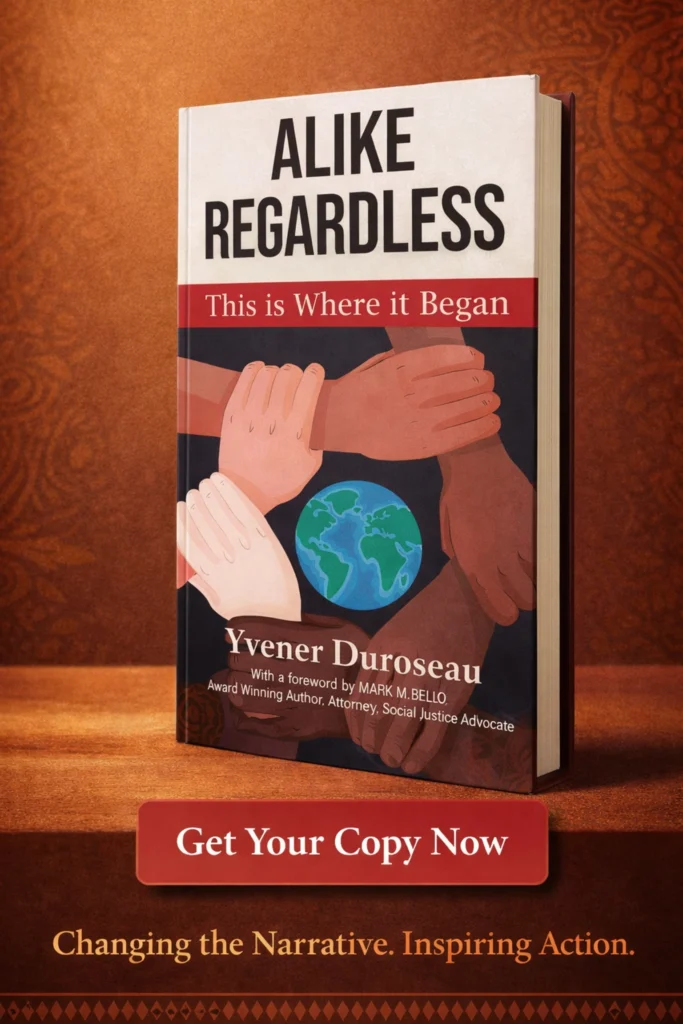
In my book, Alike Regardless: This Is Where It Began, I explore the intersections of our shared history and the fundamental unity of the human spirit.
It is a journey back to the root.
It is an attempt to see ourselves beyond the labels imposed by power.
But the root is deep, and the soil has been poisoned for centuries.
Language as a Vessel of Power
Language is not just a tool for communication.
Language is a vessel for history.
When you speak a language, you carry its biases.
You carry its hierarchies.
For many of us, our primary tongue is the language of the empire.
We process our most intimate thoughts through a filter that was once used to dominate our ancestors.
This creates a specific kind of mental exhaustion.
A constant translation of the self.
To decolonize the mind is to recognize that our native wisdom does not need to be validated by colonial grammar.
It is to realize that our stories are worth telling, even if they don't follow the Western arc of progress.
It is to sanctify our own voices.
The Silence of the Divine
Religion, too, often serves as a colonial anchor.
We pray to images that look nothing like us.
We adopt dogmas that were used to justify our own subjugation.
We are told that the divine is found in the texts of the conqueror, while our own spiritual traditions are dismissed as "superstition."
This is a profound form of mental bondage.
It separates us from our ancestry.
It creates a spiritual vacuum where we are forced to borrow the holiness of others.
True mental liberation requires us to reclaim the sacred.
Not to process pain, but to transform it.
Not to endure the world, but to reimagine it.

The Upcoming Work: Decolonization of the Mind
The path forward is not a straight line.
It is a spiral.
We return to the same questions, but each time we have more clarity.
The theme of "Decolonization of the Mind" is the horizon I am walking toward.
It is the next layer of the work.
It is an upcoming intellectual exploration into the very architecture of our thoughts.
We must ask: Whose voice is speaking when I am silent?
Whose desires am I fulfilling when I work?
Whose God am I calling upon when I suffer?
These questions are uncomfortable.
They are meant to be.
Comfort is the sedative of the colonial mind.
Uncertainty is the birthplace of freedom.
The Practice of Being
Decolonization is not a destination you reach.
It is a practice you maintain.
It is the daily act of reclaiming the narrative.
It is the quiet urgency of rediscovering our own worth.
We must become the authors of our own liberation.
We must stop seeking permission to be whole.
Modern identity is often a collection of fragments held together by external pressure.
Decolonization is the process of letting those fragments fall away so the core can breathe.
It is about positionality.
It is about recognizing where we stand in the structure of power and choosing to move.

The world tells us that decolonization is about the past.
I tell you it is about the future.
It is about the world we will build when we are no longer afraid of our own shadows.
It is about the human unity that can only exist between equals.
Not an equality that is granted, but an equality that is realized.
We are not victims of history.
We are the architects of what comes next.
One thought at a time.
One unlearning at a time.
One breath of freedom at a time.
The mind is the final frontier.
Take it back.